.webp)
Are You Ready to Witness the Future of Data Security?
Platform
Resources
©2026 QuNu Labs Private Limited, All Rights Reserved.
Armos - Quantum Key Distribution (QKD) is a state-of-the-art appliance which provides unconditional security for your critical data by leveraging the principles of quantum physics.
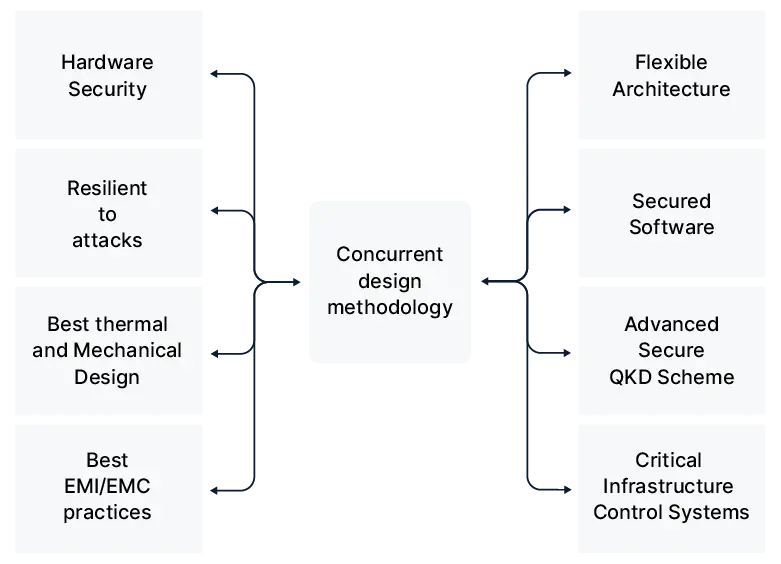
Armos - Quantum Key Distribution (QKD) is a state-of-the-art appliance which provides unconditional security for your critical data by leveraging the principles of quantum physics.
Cloud platforms, financial institutions, and critical infrastructure need a Quantum Key Distribution Network (QKDN) because the encryption protecting their data today will not survive the agentic AI and quantum era. These sectors share one defining trait: data with a long shelf life. Financial records, government archives, and infrastructure control data must stay confidential for 10 to 25 years, far beyond the point at which a cryptographically relevant quantum computer can break RSA and ECC. Under the harvest-now, decrypt-later model, adversaries are already capturing this encrypted traffic to decrypt later, which means the exposure is present, not future.
QNU Labs QKDN closes this gap by allowing to use hybrid QKD network of distributing encryption keys using the laws of quantum physics and Digital QKD based on mathematical complexity. For cloud and finance, this secures interbank settlement, customer data, and inter-data-centre links. For critical infrastructure and telecom, it protects 5G backhaul and inter-agency communication across cities and states.
QNu's Armos QKD delivers this as a overlay quantum layer in control plane of existing networks. It integrates with current encryption through standard interfaces like ETSI-GS-QKD-0014 and SKIP protocol so organizations gain quantum-safe protection while their applications continue to run unchanged. For high-stakes sectors, QKDN is no longer optional infrastructure.
Quantum key distribution (QKD) uses quantum physics to securely distribute encryption keys. Armos (QKD) transmits keys using randomly generated photons over a fiber cable. These photons, in a quantum state, exchange quantum information to establish the same key at both ends.
QNu's Armos (QKD) delivers quantum keys that ensure unconditional security for two parties communicating securely, based on quantum physics. It detects eavesdroppers, providing secure symmetric key distribution for encrypting confidential data.
Any attempt to read photon information causes errors and collapses the keys, halting generation and alerting the admin. Key generation resumes when errors decrease. The key is never exchanged, making eavesdropping nearly impossible. The symmetric key remains a shared secret.
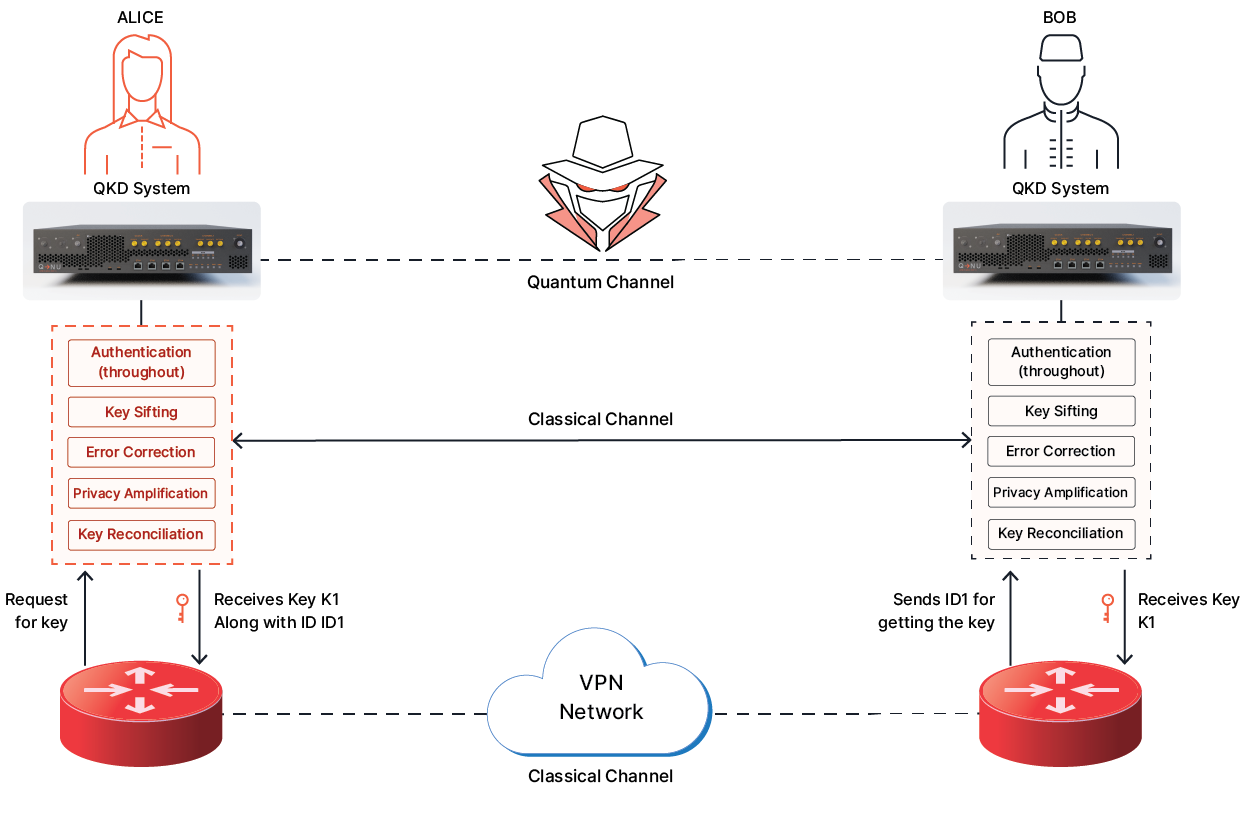
QNu’s Quantum Key Distribution Network (QKDN) architecture enables network operators to manage the full lifecycle of quantum-secure keys, including generation, distribution, and delivery. It supports multiple QKD technologies, including fibre-based and free-space QKD. At its core, Armos QKD sends randomly generated photons over standard single-mode optical fibre. Because each photon carries information in a delicate quantum state, the two endpoints can generate an identical symmetric key without the key itself ever traversing the link.
Its security is based on physics rather than computational complexity. The no-cloning theorem prevents an attacker from copying a photon’s quantum state, and Heisenberg’s uncertainty principle ensures that any measurement disturbs it. If the signal is tampered with, degraded, or intercepted in a man-in-the-middle attack, the quantum bit error rate (QBER) rises above the acceptable threshold. When that happens, the QKD system discards the affected bits, stops key generation, and alerts the security team. Key generation resumes automatically once the QBER returns below the threshold.
Its security is based on physics rather than computational complexity. The no-cloning theorem prevents an attacker from copying a photon’s quantum state, and Heisenberg’s uncertainty principle ensures that any measurement disturbs it. If the signal is tampered with, degraded, or intercepted in a man-in-the-middle attack, the quantum bit error rate (QBER) rises above the acceptable threshold. When that happens, the QKD system discards the affected bits, stops key generation, and alerts the security team. Key generation resumes automatically once the QBER returns below the threshold.
Securing a large enterprise is very different from protecting a single connection. Modern organisations operate complex networks across data centres, branch offices, cloud regions, and partner ecosystems, all carrying sensitive traffic that must remain secure in the quantum era. Scalable QKD addresses this challenge by extending quantum-secure key distribution across the entire environment, not just one isolated link.
QNu Labs’ Armos QKD system is built to scale through a networked, multi-node architecture. Trusted nodes connect individual quantum links, allowing keys to be relayed securely over longer distances and across multiple sites. As demand grows, new nodes can be added to extend coverage, enabling a deployment that starts with one critical route to evolve into an enterprise-wide quantum-safe network.
For banks, telecom operators, government agencies, and large enterprises, this scalable model turns quantum-safe security from a pilot project into production infrastructure that protects the entire network today and well beyond Q-Day.
Today’s complex network infrastructure has been built over time and each of the devices have a specific role to play. With such complexities being a reality, Armos quantum key distribution (QKD) can be deployed in any present cryptographic system.
The quantum layer sits on top of the existing network, making the deployment and adoption seamless - be it a data centre or a hybrid model.

Armos QKD enables to create secure encryption keys for any two ends of a communication link for Symmetric Key Encryption system without ever sharing the actual keys on any links.

"At Urban Matrix, we have leveraged QNu's encryption APIs for our multiple communication channels. We are also collaborating with QNu Labs for the joaaint development of quantum secure communication for our UAVs targeting the Indian defence. We are pleased to be working with a pioneer in quantum encryption technology."
Rishabh Verma | Co-Founder and CEO - UrbanMatrix Technologies