Are You Ready to Witness the Future of Data Security?
Platform
Resources
©2026 QuNu Labs Private Limited, All Rights Reserved.
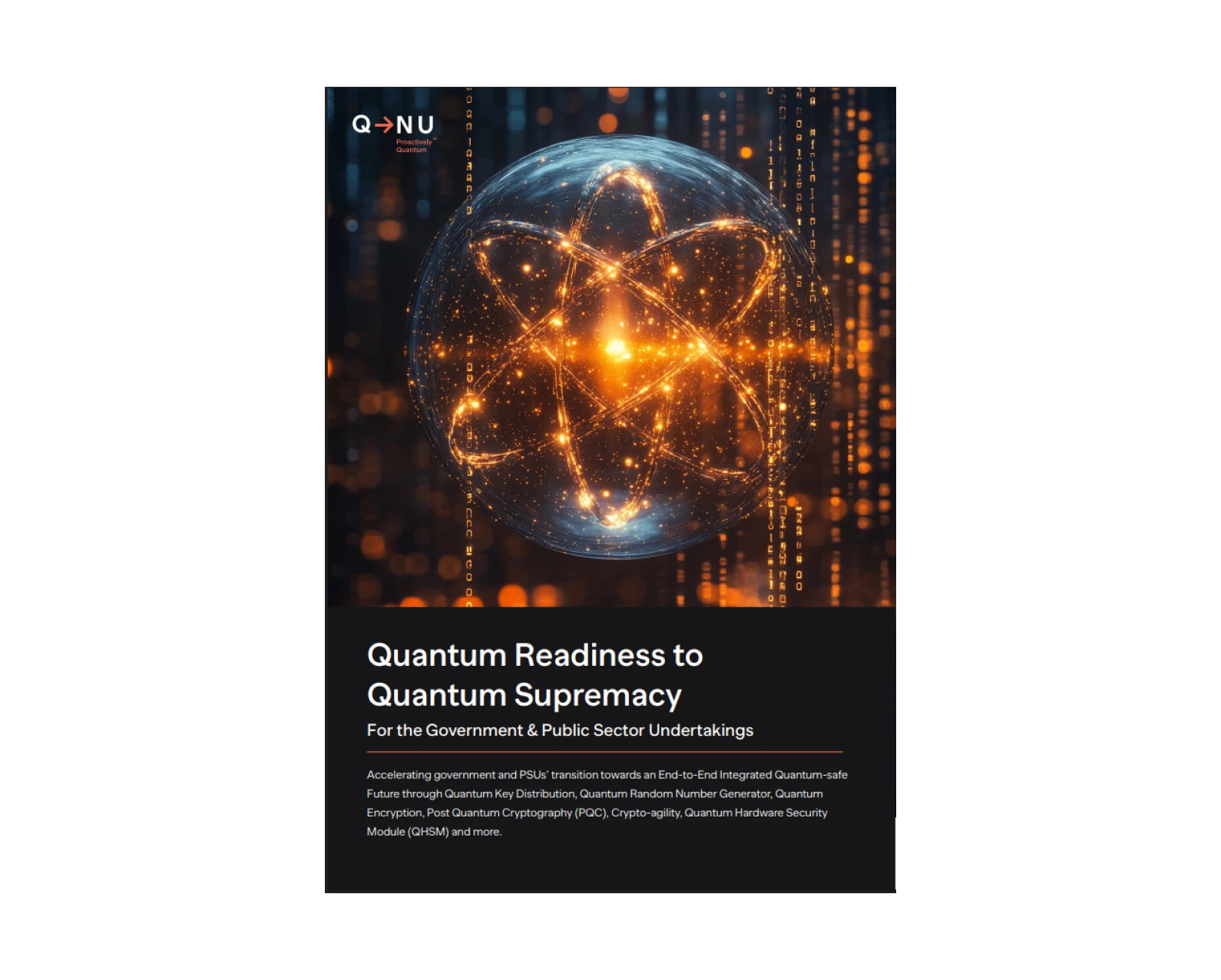
The window for securing government and PSU systems against quantum threats is narrowing. India's National Quantum Mission, backed by ₹6,003.65 crore, positions quantum readiness as both national security imperative and strategic advantage. Between 2026 and 2031, quantum computers will break RSA-2048 encryption protecting Aadhaar databases, defence communications, PSU banking transactions, and power grid commands.
Over 20 lakh cybersecurity incidents targeted Indian government systems last year. BSNL suffered major data breaches exposing 278GB of user information, while SCADA systems controlling energy infrastructure faced 3.6 million attacks in six months. Yet the more insidious threat operates silently: harvest now, decrypt later attacks where adversaries capture encrypted PSU data today, storing it until quantum computers mature.
NIST-approved post-quantum cryptography algorithms—CRYSTALS-Kyber, CRYSTALS-Dilithium, and SPHINCS+—form the mathematical foundation of quantum-resistant security. Quantum key distribution uses physics to create unbreakable encryption keys, detecting any eavesdropping attempt instantly. Quantum random number generators provide true randomness for cryptographic strength. Combined, these technologies form the quantum trinity for comprehensive PSU cybersecurity.
The National Quantum Mission establishes satellite-based quantum communications across 2,000 kilometers, inter-city quantum key distribution over existing fiber networks, and multi-node quantum networks with quantum memories—technologies designed specifically for government and PSU deployment. MeitY's quantum security roadmap, validated by CERT-In, establishes clear implementation phases prioritizing critical infrastructure first.
China operates 2,000-kilometer quantum networks for secure military communications. The United States mandated federal agencies transition to post-quantum cryptography by 2035. NATO endorsed quantum technology in its Emerging and Disruptive Technologies Strategy. India's quantum preparedness determines whether PSUs achieve technological sovereignty or digital vulnerability.
QNu Labs develops indigenously built quantum security solutions giving government organizations tools for quantum supremacy. Our quantum key distribution system Armos and quantum random number generator Tropos carry certifications from Indian defence authorities. We've deployed 300-kilometer QKD networks for the Indian Army and quantum labs protecting mission-critical infrastructure.
Cyber incidents against Indian finance handled by CERT jumped to 16 million in 2023, up from 53,000 in 2017. When adversaries decrypt classified PSU communications, consequences include exposure to citizen data, compromise of strategic planning, and loss of operational sovereignty. Every month of delay increases data adversaries capture for future decryption. QNu builds end-to-end, scalable quantum encryption systems with crypto agility at their core, integrating seamlessly with existing PSU infrastructure.
Quantum readiness provides foundation for quantum supremacy—strategic advantage through unbreakable communications, quantum sensors, and quantum-enhanced intelligence capabilities. QNu's philosophy: "Quantum-secure. Nation-first. Future-ready."
Download the Complete Whitepaper to access detailed quantum security roadmap implementation, sector-specific risk analysis for energy, banking, telecom, transport, and defence, NIST post-quantum cryptography standards deployment, and the proven 7-step quantum readiness framework aligned with MeitY and CERT-In guidelines.