
Are You Ready to Witness the Future of Data Security?
Platform
Resources
©2026 QuNu Labs Private Limited, All Rights Reserved.
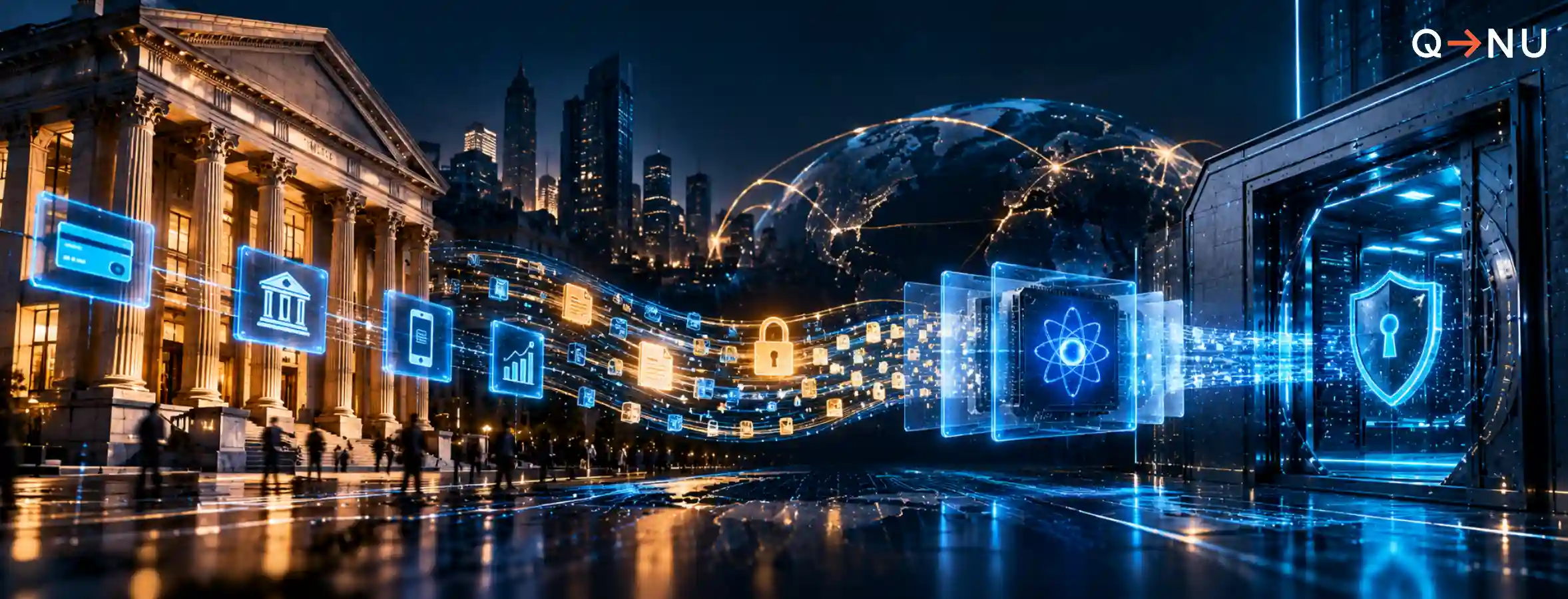
Banks hold data with the longest confidentiality requirements of any sector. KYC records, transaction histories and interbank settlement data must stay protected for ten to thirty years. That makes them the highest-value target for harvest now, decrypt later attacks, and the first sector that regulators are pressing to act.
In May 2026, the RBI constituted the Q-SAFE expert committee, whose first term of reference is a CBOM-based cryptographic inventory of the financial sector. In July, FINMA found that 72 percent of surveyed Swiss financial institutions had no quantum-safe measures planned. MAS said the same month it will issue supervisory expectations requiring financial institutions to be quantum-resilient before the end of the decade. Hong Kong's HKMA scored its banking sector at 2.3 out of 10 on its first Quantum Preparedness Index.
These are not future signals.
A sufficiently capable quantum computer running Shor's algorithm will break RSA and elliptic-curve cryptography. That machine does not exist yet. The collection of encrypted data to decrypt later does not require it. SWIFT processes over 45 million financial messages daily. Customer account data flows across every channel. Adversaries storing that traffic today need only wait. Executive Order 14412, signed in June 2026, explicitly warns that ongoing cyber activity presents the risk of adversaries collecting information now for future decryption.
No bank whose key exchange relies solely on classical RSA or elliptic-curve cryptography is safe from harvest now, decrypt later. The exposure is not at Q-Day. It is today.
The same algorithms sit beneath every layer:
Message authentication and key exchange run on RSA and ECDSA. Individual banks must secure their own endpoints regardless of SWIFT's central migration timeline.
API authentication between banks and NPCI uses RSA and ECDSA certificates. Transaction signing and merchant QR code authentication depend on the same family.
TLS certificates, session tokens, API encryption and mobile app pinning all use classical public-key algorithms. Internet banking is also the fastest system to migrate: IETF published RFC 10024 in August 2026, standardising hybrid ML-KEM key exchange for TLS 1.3. By April 2026, two-thirds of TLS traffic on Cloudflare's network was already negotiating a hybrid post-quantum key exchange.
Migration is a programme, not a project. A steering committee covering the CISO, CTO, Head of Compliance and Head of Digital Channels sets scope, owns budget and drives vendor engagement. HSM manufacturers, core banking vendors and payment platform providers must all be engaged early to understand their PQC support timelines.
The Cryptographic Bill of Materials (CBOM) is the starting point for every step that follows. The RBI Q-SAFE committee has made this explicit. The CBOM must cover TLS endpoints, HSMs, PKI hierarchies, SWIFT certificates, UPI APIs, ATM networks and mobile banking APIs. Without it, migration is guesswork. QShield 2.0 automates this discovery through QNu's National Cryptographic Assessment and Assurance Framework.
Rank systems across three axes: the confidentiality window of the data they protect, their exposure to harvest now, decrypt later collection, and migration difficulty. SWIFT and interbank messaging rank highest on all three. Core banking systems protecting long-lived customer data come next. Internet banking TLS endpoints rank high on risk but low on difficulty: enable X25519MLKEM768 on load balancers now. HSMs and ATM infrastructure take the longest lead time and need vendor engagement before any other work begins.
Hybrid deployment pairs a classical algorithm with a post-quantum one. A session stays secure if either algorithm is compromised, and it stays compatible with partners that do not yet support PQC. Target algorithms are ML-KEM (FIPS 203) for key exchange and ML-DSA (FIPS 204) or SLH-DSA (FIPS 205) for signatures. Run them alongside classical algorithms during the transition, then retire the classical modes once confidence is established.
PQC algorithms carry larger public keys and signatures than their classical equivalents. Validate performance under realistic load before production rollout, and confirm that HSMs support PQC key operations either through firmware updates or hardware replacement. Test interoperability with SWIFT Alliance, NPCI APIs and major correspondents before full deployment. Continuous monitoring should be in place by the end of the rollout period.
Months 1 to 6: CBOM, governance, vendor engagement and quick wins on internet banking TLS. Months 7 to 18: hybrid pilots on SWIFT connections, internal PKI migration, HSM upgrades for priority systems. Months 19 to 36: phased rollout across core banking, payment systems and ATM infrastructure. India's DST sets 2029 as the full quantum-safe deadline for critical infrastructure. A 36-month programme starting now meets it.
The destination is not compliance with today's standards. It is a crypto-agile estate where algorithms can be swapped again without application rewrites: centralised key management through the Quantum Key Management System, cryptographic dependencies documented in the CBOM, and QRNG entropy as the root of trust.
Every third-party platform is part of the bank's cryptographic attack surface. Procurement policies should require PQC readiness as a contract condition. FINMA's July 2026 guidance specifically calls out vendor engagement as a migration priority. MAS's forthcoming supervisory expectations include governance frameworks alongside inventory and migration planning.
India's RBI Q-SAFE report is due within six months of the committee's first meeting. DST sets 2029 for critical information infrastructure. NIST's draft IR 8547 proposes deprecating quantum-vulnerable algorithms after 2030. The EU sets 2030 for high-risk financial systems. Every framework starts in the same place: inventory first, migration second.
Banks with a CBOM in place when the Q-SAFE report lands will be positioned to act. Those without one will still be building the foundation.