

Are You Ready to Witness the Future of Data Security?
Platform
Resources
©2026 QuNu Labs Private Limited, All Rights Reserved.
TL;DR
By 6 November 2026, India's four major telecom operators had been involved in multiple rounds of discussions with the Department of Telecommunications over AI-driven cyber threats. The objective was to assess existing safeguards and strengthen network security. But those discussions raise a bigger question: while operators prepare for attacks that are possible today, are they also preparing for the cryptographic threats that could emerge tomorrow?
The trigger is AI. The Department of Telecommunications has held three to four rounds of review with Jio, Airtel, Vi and BSNL to check their firewalls and safeguards, after a run of CERT-In warnings about AI-driven attacks.
The reason is scale. UPI processed ₹31.53 lakh crore across 25.47 billion transactions in October 2026 alone, according to NPCI. That scale reflects India's growing dependence on digital infrastructure. And, on 4 November, CERT-In warned that a campaign it calls CRAFTY FALCON was using AI-assisted tools to automate attacks against banks and financial firms through their payment and disbursement APIs.
The reporting describes precautionary reviews, not a confirmed breach of an Indian telecom operator. That distinction matters: the objective is to strengthen safeguards before an incident occurs.
The response is already being written into regulation. CERT-In’s AI security audit guidelines sort AI systems into four risk tiers, from low to critical, and bring AI incidents under CERT-In’s existing six-hour reporting and 180-day log-retention rules.
The DoT already mandates annual network security audits, with external audits every three years, and runs a telecom security operations centre, and TRAI has proposed an AI governance framework with risk classification and incident reporting. All of it guards the threat you can see.
A telecom core is an aggregation point. It carries and connects vast volumes of sensitive communications and data across the country's digital infrastructure.
India’s exposure is the cost of its own success. As the country has digitised banking, healthcare, governance and everyday services at extraordinary scale, the volume of sensitive information moving through and depending on its networks has grown with it. Much of this information relies on cryptographic systems that sufficiently capable quantum computers could eventually compromise.
The challenge is the lifespan of the data these networks protect. Banking records, health information and government communications may need to remain confidential for years, potentially longer than the cryptographic systems protecting them can be relied upon. CISA and the NSA have warned of exactly this, tying the risk to any data with a long secrecy lifetime. That makes post-quantum migration an infrastructure priority, not simply a future technology upgrade.
The deadline is no longer vague. NIST's final IR 8547, published in October 2026, sets out the transition from quantum-vulnerable cryptographic algorithms to post-quantum standards. The US federal migration target is 2035, with earlier milestones of 2030 for key establishment and 2031 for digital signatures for specified high-value assets and high-impact systems. These are US federal timelines, but they offer an important reference point for organisations planning their own quantum-safe migration.
This is not a forecast. Telecom equipment can remain in service for a decade or more, making cryptographic migration a long-term infrastructure challenge. Operators in several markets have begun deploying QKD, PQC or hybrid approaches, depending on their networks and security requirements.
The GSMA's February 2026 research also shows that adoption is still developing. It found that 60% of surveyed operators had quantum technologies in their roadmaps, while 40% had no plans in theirs.
Across Europe and Asia, operators including Deutsche Telekom, Orange, NTT and SoftBank are running quantum-safe programmes of their own, and the GSMA runs a Post-Quantum Telco Network taskforce. The shift runs wider than telecom: more than half of all human web traffic is already post-quantum (Cloudflare, 2025), and Apple, Google and Signal have shipped it to billions of devices. India has established technical standards, migration guidance and indigenous quantum-security capabilities. The next challenge is translating these foundations into coordinated, operational migration across telecom networks.
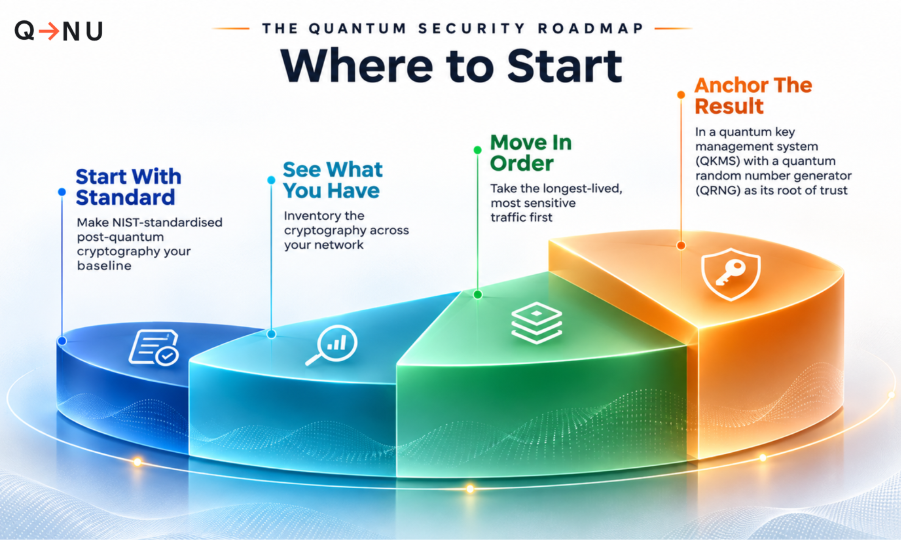
The operators already migrating did not try to fix everything at once. They followed an order of operations, and you can copy it.
Start with the standard. Make NIST-standardised post-quantum cryptography your baseline, so every new deployment ships quantum-safe.
See what you have. Inventory the cryptography across your network, find where RSA and elliptic-curve keys live, and rank systems by risk and data lifetime. You cannot migrate what you cannot see.
Move in order. Take the longest-lived, most sensitive traffic first, then anchor the result in a quantum key management system (QKMS) with a quantum random number generator (QRNG) as its root of trust.
Quantum will not break your encryption on the day it arrives. It will read everything you sent before you were ready. Every day of delay adds to someone’s decrypt-later pile, and 2030 is closer than your next network refresh.
Build Your Quantum-Safe Roadmap · Read the Quantum-Safe Zero-Trust Blueprint
Sources