


Are You Ready to Witness the Future of Data Security?
Platform
Resources
©2026 QuNu Labs Private Limited, All Rights Reserved.

TL;DR
The story begins not with a threat but with a decision. On 16 June 2026, at the France Quantum conference at Station F in Paris, Samih Souissi, chief of staff of France's national cybersecurity agency ANSSI, told the room that from 2027, ANSSI will stop certifying security products that do not incorporate post-quantum cryptography. Reuters was in the room. The date was not new: it had been signalled in position papers since 2022 and confirmed in ANSSI's FAQ since 2023. What changed on 16 June was that a government official said it publicly, at a major industry event, with press present. The transition stopped being a position paper and became a market commitment.
ANSSI's certification, known as qualification, is a prerequisite for security products used across French government agencies and operators of vital importance covering energy, telecommunications, finance, and transport. A product without qualification is effectively locked out of one of Europe's largest public technology markets. The deadline is not 2030. It is 2027.
France set the most aggressive timeline in Europe, but it did not act alone. The broader European regulatory architecture has been moving on the same trajectory, and the convergence of multiple instruments in 2025 and 2026 has created a compliance geometry that any organisation operating across the UK and Europe must now navigate simultaneously.
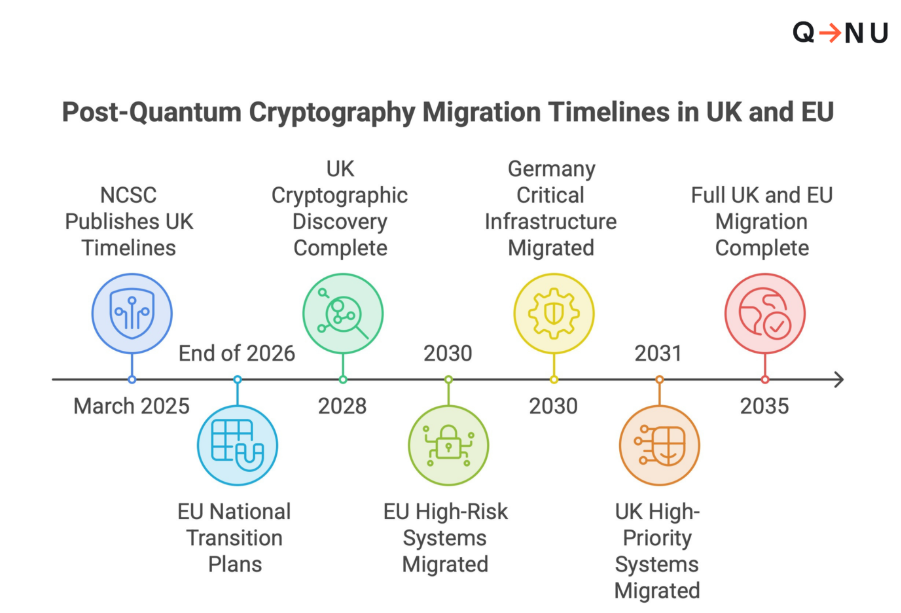
In March 2025, the UK's National Cyber Security Centre published its Timelines for Migration to Post-Quantum Cryptography, setting three phased milestones. By 2028, all organisations should have completed cryptographic discovery: identifying every algorithm, key, certificate, and dependency across their estate. By 2031, high-priority systems, specifically critical national infrastructure and the most exposed operational technology, should have completed migration. By 2035, the full transition should be complete. The NCSC framed the urgency plainly: harvest now, decrypt later attacks are active, and sensitive encrypted data should be assumed already collected by adversaries waiting for quantum hardware to mature.
The NCSC guidance carries particular weight for organisations operating in regulated UK sectors. GDPR's Article 32 requires appropriate technical measures to protect personal data. With the NCSC publicly stating that the harvest-now threat is current rather than future, the argument that classical encryption remains appropriate for long-lived sensitive data is weakening in the eyes of regulators. Inaction carries legal as well as operational risk. The consequences, as Venari Security's analysis of the converging regulatory framework makes clear, can include GDPR fines of up to four percent of global turnover and DORA enforcement with personal liability of up to one million euros for responsible executives.
France, Germany and the Netherlands jointly led the development of the EU's Coordinated Implementation Roadmap for PQC, published in June 2025. Its three milestones mirror the NCSC's structure: national transition plans by end of 2026, high-risk systems migrated by end of 2030, and full migration by end of 2035.
Germany's BSI has published technical guidance under TR-02102 setting its own expectations for cryptographic agility and hybrid deployment, with critical infrastructure targeted by 2030. The Netherlands' NCSC-NL has published aligned guidance, with a stated ambition to reach a top-three global quantum position by 2035 backed by more than two billion euros in combined public-private investment under Quantum Delta NL.
ANSSI's hybrid mandate carries a specific technical implication that matters beyond France. It requires hybrid constructions for both key encapsulation and signatures, and has reserved the right to accept algorithm sets that diverge from NIST's selections, naming FrodoKEM alongside ML-KEM as an acceptable alternative. A vendor selling into France, Germany and the Netherlands simultaneously must satisfy three overlapping but not identical technical requirements. Building to NIST FIPS 203 alone is necessary but not sufficient for European market access.
The EU's NIS2 Directive, which entered force in October 2024, requires operators of essential services to apply appropriate and proportionate technical measures. The EU's DORA regulation, in force since January 2025, applies equivalent obligations to financial services. Neither instrument yet mandates PQC explicitly, but both create a framework in which regulators can and increasingly do read quantum readiness into proportionality assessments for long-lived sensitive data. The pending EU Quantum Act, expected in the same window as the Netherlands' 2035 ambition, could give those assessments formal teeth.
The UK's position carries a dimension the EU roadmap does not: industrial leverage. Oxford Instruments, a UK company, is one of a handful of firms globally manufacturing dilution refrigerators at the scale needed for advanced quantum computing hardware. As The Quantum Insider's geopolitical analysis notes, this is a genuine supply-chain choke point that gives the UK structural influence in the quantum hardware ecosystem regardless of any strategy document. The UK's £2.5 billion National Quantum Strategy, extended by a further £2 billion in March 2026 and anchored by ProQure, the world's first government quantum procurement programme, is building atop that industrial base rather than starting from scratch.
Sir Peter Knight, chair of the UK's National Quantum Technology Programme Strategic Advisory Board, has described the logic in direct terms: "We want to make sure that we're in the game. We want to be among the first countries to actually benefit from a scaled quantum computer. We want to make sure that we actually anchor this into the UK."
For organisations operating across UK and European markets, the compliance picture that emerges from 2025 and 2026 is not a single deadline. It is a sequence of gates arriving in rapid succession.
ANSSI's 2027 certification gate is the first. Any security product sold into the French market that needs qualification must have a post-quantum roadmap in place now, given that ANSSI qualification processes take 12 to 18 months. The UK's 2028 cryptographic discovery milestone is next: organisations that have not completed a Cryptographic Bill of Materials by then are already behind the NCSC's phased expectation. The EU's 2030 high-risk system migration target follows. And 2035 is the full completion date across both frameworks.
The organisations that read these as a planning horizon have time. Those that read them as a compliance deadline that applies in year five will arrive in 2031 having missed the first three gates.
Harvest now, decrypt later means the data collection phase for many of these organisations is already over. What remains is the window to act before the decryption phase begins. That window is defined by the deadlines above, not by Q-Day.