

Are You Ready to Witness the Future of Data Security?
Platform
Resources
©2026 QuNu Labs Private Limited, All Rights Reserved.

On 25 September 2025, the RBI released its Authentication Mechanisms for Digital Payment Transactions Directions, 2025 — arguably one of its most consequential digital payments initiatives of the decade.
The headline is simple: every digital payment transaction now requires two-factor authentication (2FA). This is not optional, not recommended, but rather mandatory. SMS OTPs, which have done the heavy lifting since 2009, are no longer the only acceptable method. The RBI now recognises PINs, passphrases, biometrics, software tokens, and device binding as legitimate authentication factors.
If you are a bank, fintech, payment aggregator, or NBFC operating in India, this one has your name on it.
Yes, it’s a good move. Long overdue, frankly. India processes more than 18 billion UPI transactions a month. The old framework was showing its age.
But here is where it gets uncomfortable.
Every authentication mechanism — the OTPs, the tokens, the biometrics, the digital signatures sit on top of classical cryptography. And classical cryptography has a shelf life. It expires the day a quantum computer is powerful enough to crack it. That day has a name: Q-Day.
Nobody in the compliance boardrooms seems to be addressing it. We think that is non-negotiable.
Before getting into the quantum problem, let’s give credit where it’s due. The RBI’s 2025 authentication directions are genuinely well-constructed. They are principle-based rather than prescriptive, which gives banks room to innovate. And they cover a lot of ground.
Three things stand out.
Every domestic digital payment needs at least two distinct authentication factors. The categories are what you would expect: something the user has (a card, a hardware token, an OTP pushed to a registered device), something the user knows (password, PIN, passphrase), and something the user is (fingerprint, face, iris). Making this mandatory across the board is a significant shift.
The RBI is not asking for a checkbox. Issuers are expected to think on their feet. If a transaction looks suspicious — unusual location, unfamiliar device, behaviour that doesn’t match the customer’s profile — the bank should layer on extra verification. The RBI has even floated DigiLocker as a potential platform for flagging high-risk transactions.
Card issuers have until 1 October 2026 to sort out authentication for non-recurring cross-border card-not-present transactions. That means registering BINs with card networks and building risk-based controls for international card use. The RBI is effectively closing the cross-border loophole.
Taken together, it’s a solid framework — technology-agnostic, forward-looking, and flexible. But that flexibility is precisely what makes the next problem so dangerous: the RBI does not tell you which cryptographic foundation to build on. And that’s the part that is about to break.
Here is the thing about 2FA (Two-factor authentication). Two locks instead of one may feel reassuring, but every digital authentication mechanism ultimately relies on cryptographic algorithms for key exchange, digital signatures, and data integrity.
This is not theory. Shor’s algorithm factors large integers and computes discrete logarithms in polynomial time — precisely what RSA and ECC depend on being impossible. A sufficiently powerful quantum machine makes it trivial. Whether you are using SMS OTPs, FIDO2 passkeys, biometrics, device certificates, or TLS, they all trace back to RSA, ECC, or Diffie-Hellman somewhere in the chain.
Sophisticated attackers are not waiting for quantum computers to arrive. They are already collecting encrypted financial data today — payment flows, SWIFT messages, inter-bank settlement instructions — and storing it. The plan: sit on it, wait for quantum computing to mature, then decrypt everything at once. The US Federal Reserve flagged this explicitly in 2025. Their conclusion: the privacy damage from harvest now, decrypt later attacks cannot be fully undone after the fact.
For Indian banks, this means every digital transaction authenticated today using classical 2FA could be retroactively compromised. Transaction records sit in databases for a decade or more. Digital signatures on loan documents are stored for 10 to 25 years under RBI and Income Tax rules. Every one of those records becomes vulnerable when Q-Day arrives.
The RBI’s 2025 Directions secure the front door. Quantum computing is the wrecking ball headed for the foundation.
QNu Labs is India’s first quantum cybersecurity company, incubated at IIT Madras Research Park. It’s backed by India’s National Quantum Mission and other global investors with 25 patents. QNu Labs has been trusted globally by various enterprises including, banking, defence, telecom, and government. This is real hardware, real software in production in India and globally.
QNu does not just help banks comply with the RBI’s latest requirements. QNu future-proofs them.
QShield™ is the world's first hybrid full-stack quantum security platform, combining quantum physics and advanced mathematics to protect seven layers of security - from hardware, OS, and software through networks, data centres, and services, all the way to endpoints and applications. No single perimeter. No single point of failure.
At its core, QShield manages the complete cryptography lifecycle seamlessly: key generation, key distribution, key management, and advanced next-generation encryption protocols — all through a unified interface. It is rapidly scalable and easy to deploy without disrupting existing infrastructure.
Running on AWS, QShield delivers centralised, SaaS-based quantum security services: quantum-safe VPN (QConnect), quantum-safe messaging and collaboration (QVerse), secure file sharing, and quantum-safe data storage - all managed from a single control plane.
For a bank, this means the same platform that secures a core banking link also secures the OTP a customer receives, the SWIFT message a treasury desk sends, and the file a relationship manager shares without requiring separate point solutions for each.
There is a temptation to treat April 2026 as the finish line — get the 2FA boxes ticked, file the compliance report, and move on. That is a mistake. The quantum timeline does not care about the RBI’s compliance calendar.
The RBI gave India a compliance framework for today. QNu gives India a security framework for the long haul. When it comes to quantum security, the only safe time to move is before you must.
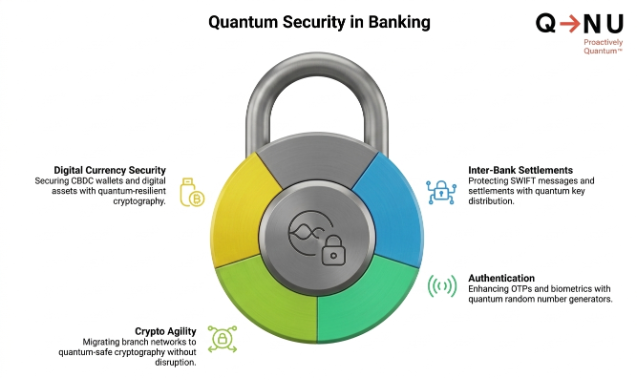
The BFSI sector handles transactions that are high in value, high in volume, and long in shelf life. That combination makes it a primary target for Harvest Now, Decrypt Later attacks where adversaries collect encrypted data today, intending to decrypt it once quantum computers are capable enough. The threat isn't theoretical; it's already in motion.
Every SWIFT message, every inter-bank settlement, every core banking link is only as secure as the keys protecting it. Classical encryption assumes that breaking those keys is computationally hard quantum computers will make that assumption obsolete. Armos QKD protects these channels at the physical layer: attempt to intercept a quantum key and you physically disturb it, making eavesdropping immediately detectable. No compute power classical or quantum can get around that.
Most authentication systems today rely on pseudo-random number generators: mathematically deterministic, theoretically predictable. The "random" OTP a customer receives is only as strong as the entropy behind it. Tropos QRNG uses quantum photon behaviour to produce numbers that are genuinely, physically random, non-repeatable and certified.
Banks operate hundreds of branches on non-standard, heterogeneous connectivity. Migrating all of them to quantum-safe cryptography without a rip-and-replace is the real challenge. Hodos PQC and QConnect deploy NIST-standardised post-quantum algorithms directly into existing IT/OT infrastructure. A consistent "Branch in a Box" approach means every location, regardless of connectivity type, can be brought into a quantum-safe posture without disrupting operations.
As India's digital currency infrastructure scales, the cryptographic foundations protecting CBDC wallets, digital asset custody, and customer identity need to be quantum-resilient from the ground up not retrofitted later. The same hybrid approach QKD for key distribution, QRNG for key generation, PQC for interoperability covers this surface end to end.
The RBI’s 2025 Directions are a meaningful step. They close gaps that should have been closed years ago. But compliance is a floor, not a ceiling. India processes more digital payments than almost any nation on earth — and that scale makes it a target.
Quantum-safe by design is the new secure by design. Organisations that act in 2026 will set the standard. Those who wait will comply at a crisis premium — after data that should have been protected has already been harvested.
Is your organisation ready? Connect with our expert team to begin your quantum-safe journey or request a demo of the QShield platform today.
Sources & External References