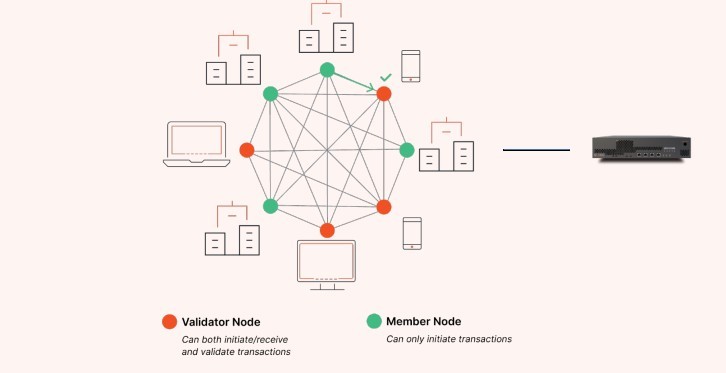
The client operates as one of the reputed next-generation blockchain infrastructure providers, delivering an EVM-compatible Layer-1 mainnet powered by Proof-of-Authority (PoA) consensus architecture. Serving the decentralised finance ecosystem, the platform enables developers and enterprises to build scalable decentralised applications (dApps) with significantly reduced transaction costs compared to traditional blockchain networks. As a pioneer in the high-performance blockchain space, they manage a globally distributed node infrastructure supporting critical operations across DeFi protocols, NFT marketplaces, gaming ecosystems, and enterprise-grade blockchain solutions. Their platform processes thousands of transactions whilst maintaining sub-second finality times.
Infrastructure: Multi-node distributed architecture using Proof-of-Authority consensus protocol, deployed across geographically dispersed validator and member nodes with EVM compatibility for Solidity smart contract execution
Solutions Deployed: Hybrid quantum security architecture combining QShieldQConnect (with NIST-compliant PQC algorithms) and Tropos QRNG (Quantum Random Number Generator)
Operational Status: 6+ months of continuous operation with quantum-secured infrastructure across the distributed node network
Business Unit: Enterprise Blockchain Security Division
"The deployment demonstrates how forward-thinking blockchain platforms can adopt quantum-safe technology today, without operational disruption or compromise. We've future-proofed our infrastructure against quantum threats while maintaining the performance and reliability our enterprise client's demand”
VP of Engineering
Overview
QNu Labs' indigenous quantum technologies enabled a world-class blockchain enterprise platform to secure mission-critical enterprise communications end-to-end and demonstrate a quantum-resilient architecture for the blockchain platform.
Challenge
As blockchain systems grow, so will the financial and regulated ecosystems, thereby making long-term cryptographic resilience mission critical. The client anticipated emerging risks and faced three key challenges:
Entropy Quality Crisis: Blockchain security fundamentally depends on the unpredictability of cryptographic keys. Software-based randomness generators are insufficient for the level of security required by institutional clients and high-value DeFi protocols demanding military-grade protection.
Vulnerability to Quantum Attacks: Traditional cryptographic protocols, which secure inter-node communication between member and validator nodes globally, can be easily broken by quantum computing. This exposes the highly sensitive data for "harvest now, decrypt later" attacks.
Regulatory & Compliance Pressures: The enterprise needed to proactively demonstrate readiness for NIST-compliant post-quantum cryptography frameworks as a prerequisite for adoption, particularly for applications handling sensitive financial data and cross-border transactions.
Operational Constraint: The solution had to be deployed with low-latency communication and ensure seamless integration without disrupting ongoing consensus or transaction processing or existing apps and smart contracts across the distributed environment.
Future-Proofing Imperative: The platform needed crypto-agility – the ability to adapt cryptographic protocols as quantum computing threats evolved without requiring a complete infrastructure overhaul.
Solutions Implemented
QNu Labs deployed a comprehensive quantum-secure blockchain architecture integrating physics-based security at multiple layers:
Physics-Based Quantum Entropy Generation
QNu Labsʼ QRNG, powered by quantum physics and precision optoelectronics, provides the client with a provably secure source of entropy for its cryptography, hashing, and digital signatures. This quantum entropy is truly random, real-time monitored, and resistant to external attacks. This makes the cryptographic keys highly unpredictable and secure. The advantages are:
Provably unpredictable: Based on Heisenberg's uncertainty principle, not computational assumptions
Real-time monitored: Continuous health checks ensure entropy quality
Attack-resistant: Immune to side-channel attacks and mathematical prediction models that compromise software RNGs
In addition, the distributed nodes of AME Chain, located across the globe, are interconnected via QNu's QShield™ QConnect, which employs PQC algorithms compliant with NIST standards. This creates a robust and quantum-resilient communication layer that cannot be broken by current or future quantum computing threats. The advantages:
Secures inter-node communication channels between geographically distributed validators and member nodes
Employs ML-KEM (Module-Lattice-Based Key Encapsulation Mechanism) for key exchange protocols
Provides forward secrecy and resistance against both classical and quantum computational attacks
Enables seamless cryptographic key rotation without service interruption
Hybrid Quantum-Classical Security Architecture
Created a layered defence strategy combining:
Quantum entropy at the cryptographic foundation (key generation, hashing, digital signatures)
PQC algorithms for network transport security
Crypto-agile infrastructure allowing algorithm migration as quantum threats evolve
QNu Labs
QNu Differentiators: Why This Deployment Succeeded
QNu Labs delivered a complete, commercially deployable quantum security ecosystem:
The Only Unified Quantum Security Platform: QNu is the only provider globally offering both physics-based QRNG and NIST-compliant PQC solutions with centralised orchestration. Competitors operate in "research mode" without deployment-ready integration, forcing blockchain platforms to cobble together disparate technologies. QNu provided a turnkey solution, giving the client complete operational control from day one.
Zero-Disruption Integration: The implementation required no modifications to the client’s existing Proof-of-Authority consensus protocol, smart contract execution environment, or user-facing APIs.
Indigenous Innovation for Global Deployment: QNu's "Made in India, Built for the World" capability demonstrates sovereign technological advancement whilst meeting international standards - NIST compliance combined with indigenous innovation delivers military-grade security with enterprise readiness.
Seamless Deployment: The implementation required no architectural changes to the existing blockchain protocol or consensus layer.
Operational Efficiency: The QShield platform provided centralised management for unified monitoring, audit logging, key provisioning, and secure tunnel management.
Crypto-Agility: The architecture is inherently flexible, supporting smooth upgrades to future PQC standards and security requirements.
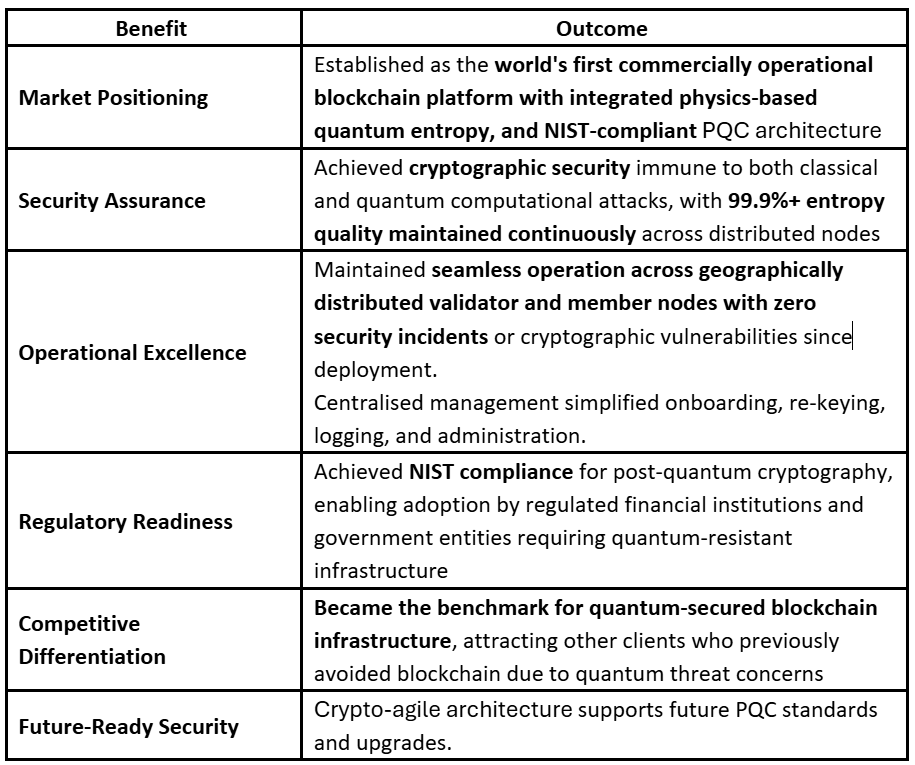
Results Achieved
The partnership positioned the client from a blockchain service provider into a quantum-secured digital infrastructure leader:
Frequently asked questions
What is Post-Quantum Cryptography (PQC) and why is it essential?
How can enterprises integrate PQC into their existing blockchain infrastructure?
What is the ‘harvest-now, decrypt-later’ threat that PQC counters?
Which PQC algorithms are recommended for securing inter-node blockchain communication?