


Are You Ready to Witness the Future of Data Security?
Platform
Resources
©2026 QuNu Labs Private Limited, All Rights Reserved.

Your bank's encrypted data from 2024 already sits on cybercriminals' hard drives and is waiting to be decrypted when the quantum computer becomes mainstream. With QuantWare's 10,000-qubit processor announced, decades of "secure" data will crack open. This "harvest now, decrypt later" attack has been occurring for the last few years, and it’s now accelerating.
2026 marks the shift from quantum awareness to action. Following 2025's International Year of Quantum Science and Technology, governments now enforce hard deadlines. The quantum computing market hit $2 billion (Investing.com, 2026), while post-quantum cryptography races from $420 million (2025) to $2.84 billion by 2030 (Market Research, 2026). Organisations have 3-5 years to overhaul encryption.
Hence, the message is very clear: Quantum security isn't tomorrow's problem. It's today's mandate.
This blog reveals the 10 critical trends shaping 2026 and the actions you must take now.
Governments worldwide are no longer suggesting quantum-safe transitions—they're demanding them.
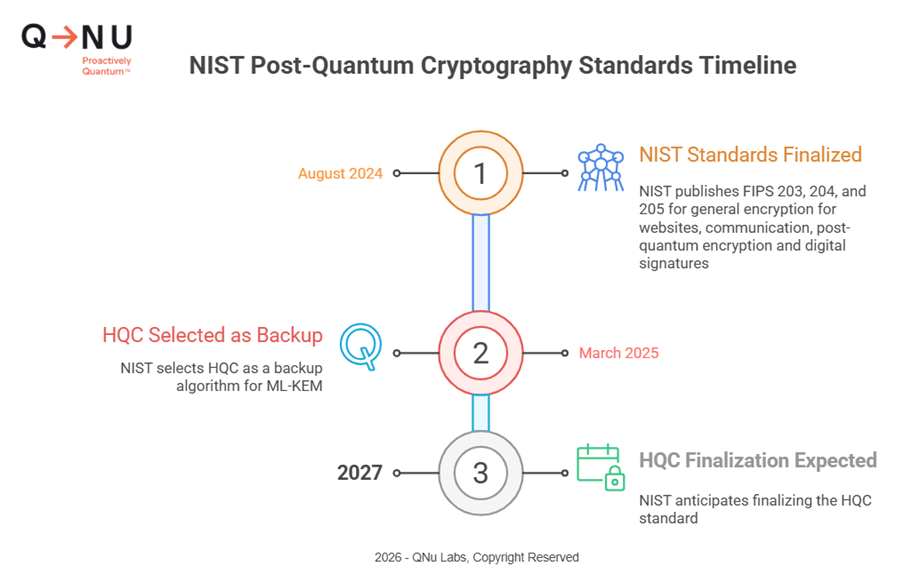
NIST Standards Published: In August 2024, the U.S. National Institute of Standards and Technology finalised three critical post-quantum cryptography standards (NIST, 2024):
A fifth algorithm, HQC (Hamming Quasi-Cyclic), was selected in March 2025 as backup for ML-KEM, with finalisation expected in 2027 (NIST, 2025).
What This Means: Every organisation using RSA, ECC, or other vulnerable encryption must migrate to these standards. The process takes 3-4 or 5 years, so starting in 2026 means finishing around 2030-31.
Adversaries aren't waiting for quantum computers—they're stealing encrypted data today to decrypt tomorrow.
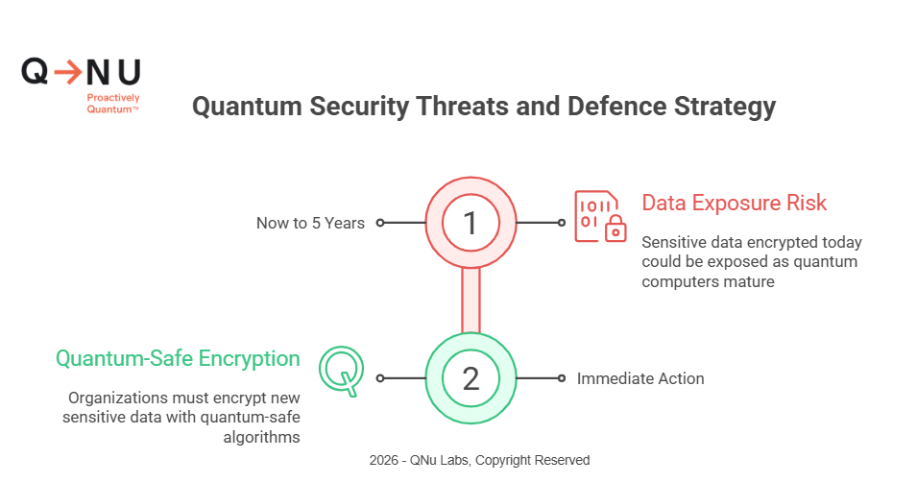
Security experts warn that sensitive data encrypted now could be exposed anytime between now to next 5 years as quantum computers mature. This particularly threatens:
Defence Strategy: Organizations must immediately encrypt new sensitive data with quantum-safe algorithms, even if full migration takes years.
Crypto-agility means building systems that can rapidly swap encryption algorithms without major disruption (Read also our whitepaper on 2026 Cybersecurity Trends).
Implementation: Abstract cryptographic functions from business logic, implement cryptographic service layers, and maintain algorithm versioning systems.
The QKD market is projected to reach $1.61 billion in 2026, with satellite-based and photonic chip systems enabling secure global networks. The QKD Market will grow to $19.47 Billion in 2035 with 31.6% CAGR (Source: Various Research Houses – Research & Markets and others).
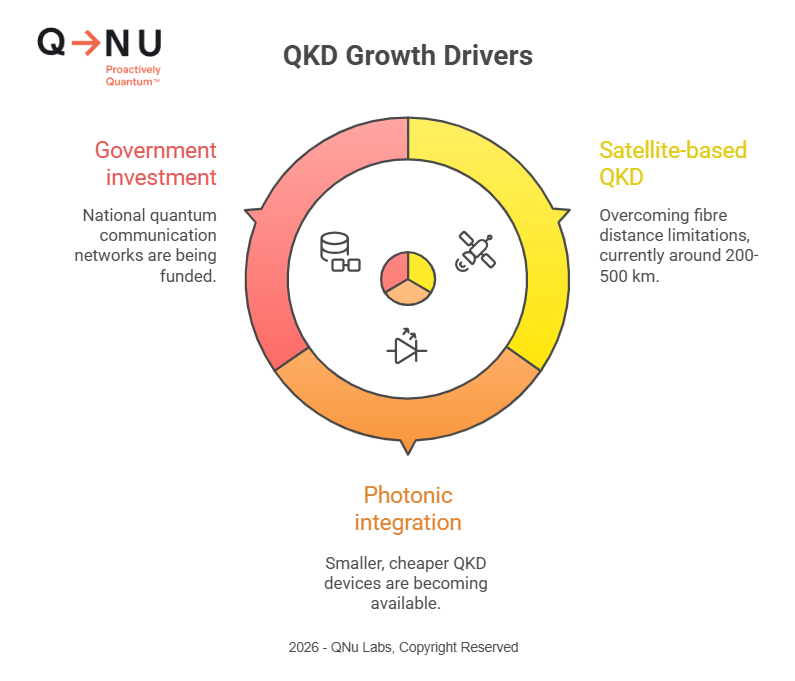
Key Application Sectors: Banking, government, defence, healthcare, telecommunications.
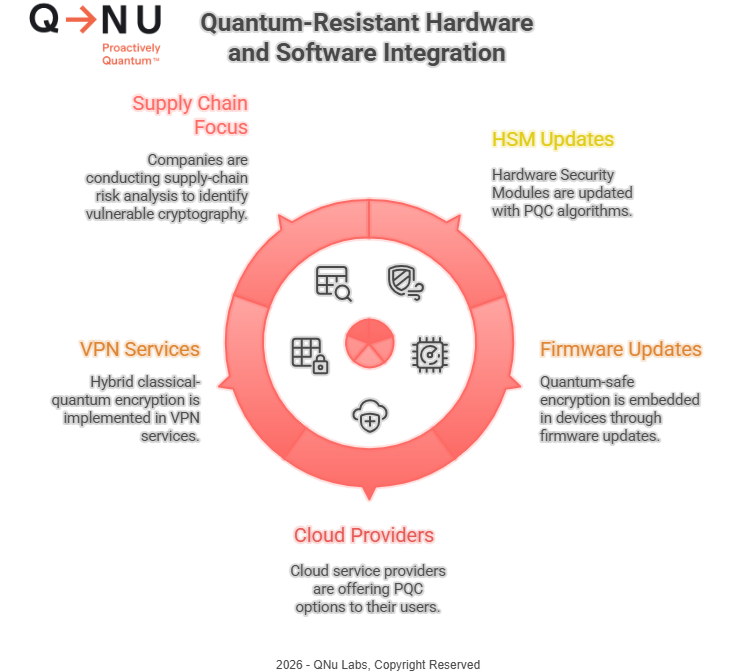
Organisations are integrating quantum-resistant solutions into legacy systems through:
Supply Chain Focus: Companies are conducting supply-chain risk analysis to identify where vulnerable cryptography exists in third-party software and hardware.
Countries worldwide are establishing quantum security mandates:
European Union: The EU Post-Quantum Cryptography Roadmap requires high-risk sectors (finance, healthcare, critical infrastructure) to begin transitions by end of 2026 (Telefonica, 2026). Full migration expected by 2030-2035.
United States: Federal agencies must inventory cryptographic systems and begin PQC migration under National Security Memorandum guidance (NIST, 2024).
United Kingdom: NCSC (National Cyber Security Centre) published detailed guidance for quantum-readiness, emphasizing cryptographic inventories and phased replacements.
Singapore: Launched the National Quantum-Safe Network (NQSN) initiative, partnering with industry to deploy quantum-secure communications infrastructure.
Middle East: UAE and Saudi Arabia investing heavily in quantum technologies as part of digital transformation strategies, with cybersecurity as priority area.
China: Operational national quantum communication backbone, mandating quantum security for critical government and financial sectors.
The numbers reveal quantum security's strategic priority:
Investment Focus Areas: QKD hardware, PQC software solutions, consulting services (45% of market), quantum-safe network infrastructure.
Artificial intelligence is accelerating both quantum threats and defences (EC-Council University, 2026):
The Year 2025 - International Year of Quantum Science and Technology achieved its goal, moving quantum from specialist circles into mainstream strategy discussions. Now, in 2026, the focus shifts from quantum awareness to quantum security implementation, recognising that protection determines deployment success.
2026 has been designated the "Year of Quantum Security" by industry leaders, emphasising international cooperation(The Quantum Insider, 2026):
Key Initiatives:
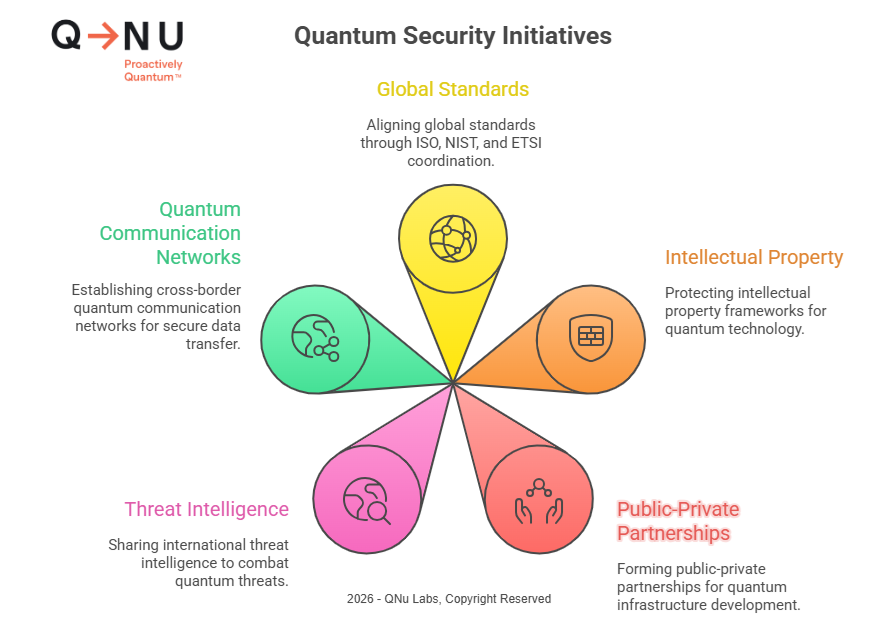
Major Conferences to participate: World Economic Forum, RSA Conference, and quantum-specific summits driving policy coordination.
With only 30,000 quantum professionals globally (Source: TieTalent) and a 3:1 job-to-candidate ratio (Source: McKinsey), the quantum workforce shortage has become critical.
While global trends accelerate, India is establishing itself as a quantum security leader through the National Quantum Mission (NQM). Investment: ₹6,003.65 crore ($725 million) from 2023-2031
Strategic Importance: Aligned with Digital India, Make in India, and Atmanirbhar Bharat (self-reliant India) initiatives, emphasising digital sovereignty and secure communication infrastructure
Step 1: Conduct Cryptographic Inventory (Q1 2026)
Step 2: Develop Migration Roadmap (Q2 2026)
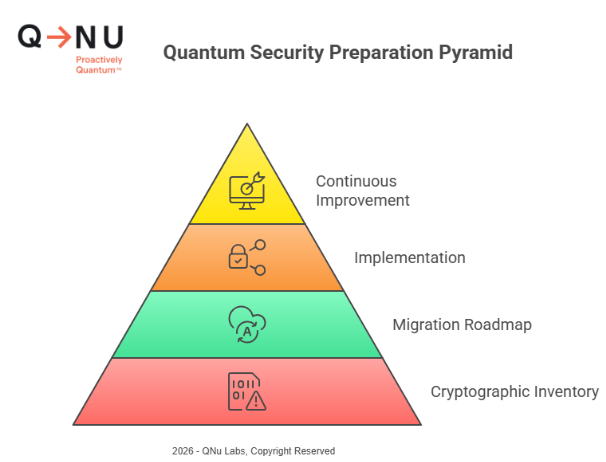
Step 3: Begin Implementation (Q3-Q4 2026)
Step 4: Maintain Continuous Improvement (Ongoing)
As India's first quantum cybersecurity company, QNu Labs pioneers quantum-safe solutions aligned with global trends, national and global (ETSI, NIST, and other countries’ quantum communication guidelines) priorities.
From Hardware to Software, Platform to Services, Infrastructure, Remote Devices, including End Points (over cloud), QShield provided 7 layers of quantum-attack protection
QNu Labs secures critical infrastructure across Banking & Finance, Telecommunications, Automobile, Healthcare, IT and Defence & Government with proven quantum-safe solutions for communications, networks, and sovereign security operations. Successfully deployed across India and globally, check here to know more: View QNu Case Studies
Also, to start your skilling journey in Quantum Communications, go through the QNu-powered crash course: Foundation in Quantum Safe Communication and get certified by QNu Labs by taking the real-time test here (self-paced). QNu is also the pioneer in democratising quantum security skills globally and in India.
The Bottom Line: 2026 Is Your Deadline
Quantum computers capable of breaking encryption arrived in 2025 and will become mainstream by 2028-2035. Organisations need 3-5 years to migrate systems—start in 2026, finish by 2029-2030.
Global consensus is clear: EU mandates, NIST standards, and explosive market growth demand immediate action. Leading nations (USA, China, EU, Singapore, India, Middle East, UK) are establishing competitive advantages through quantum-safe infrastructure now.
“The question isn't whether quantum computers will break encryption, it's whether your organisation will be protected when they do.”
Your next step: Conduct a quantum vulnerability assessment, develop your migration roadmap, and partner with proven experts like QNu Labs to secure your data's future across all seven layers: from hardware to services, network to edge, platform to infrastructure.