

Are You Ready to Witness the Future of Data Security?
Platform
Resources
©2026 QuNu Labs Private Limited, All Rights Reserved.

Q-Day may arrive in 36 months. That’s IonQ CEO Niccolo de Masi’s stark warning at Davos this January (CNBC, July 2025). Within three years, quantum computers could crack RSA and ECC encryption, securing 95% of global digital communications—from banking to defence systems.
Google declared at Davos that quantum computing today mirrors AI as it was five years ago, just before its explosion. At Davos 2026 (weforum.org), quantum security dominated discussions, displacing AI as the most urgent challenge. Adversaries aren’t waiting—they’re harvesting encrypted data today in “Harvest Now, Decrypt Later” attacks.
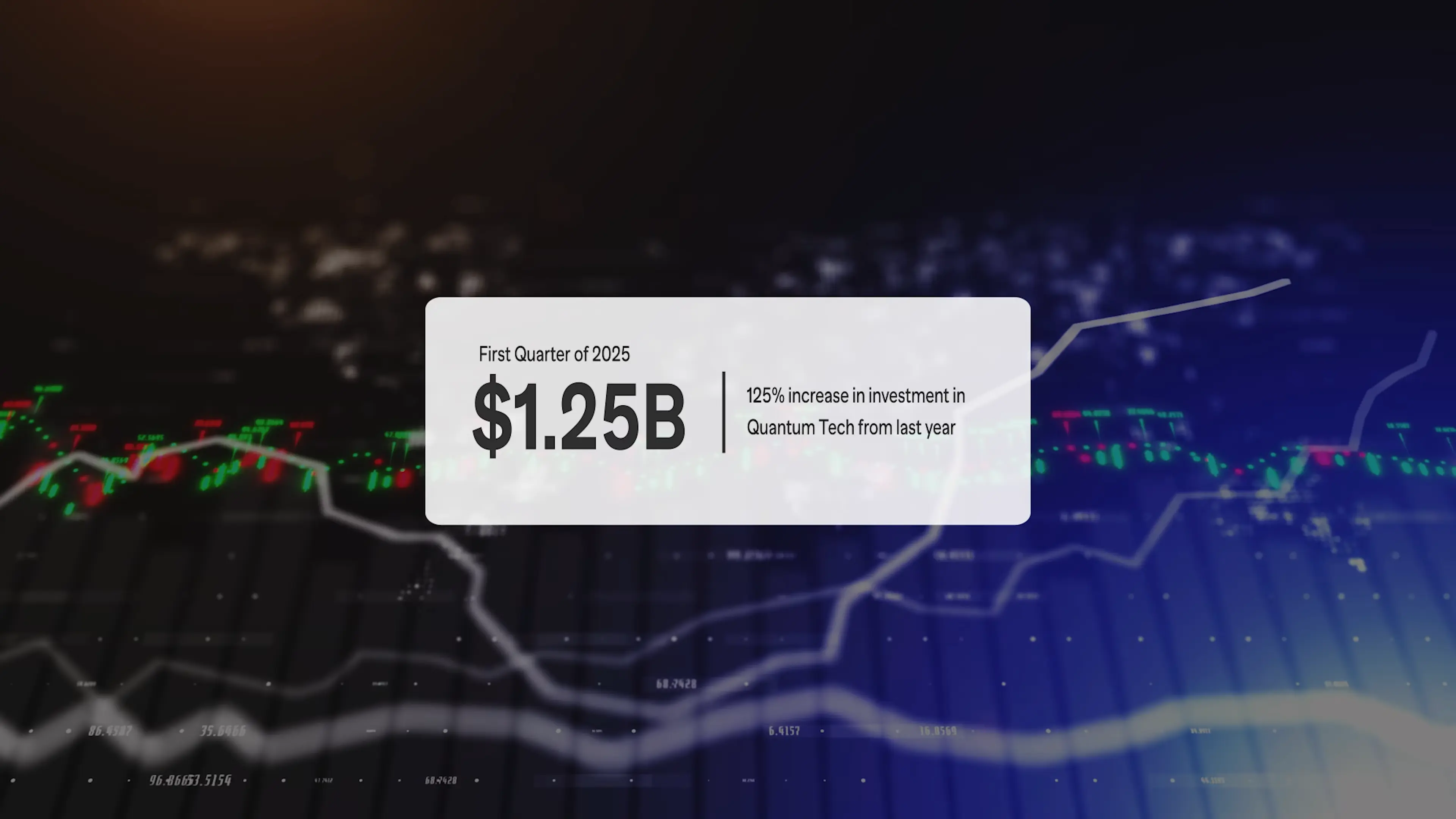
The 55th WEF gathered 3,000+ leaders under “Collaboration for the Intelligent Age” (AI for Good, January 2025). ITU Secretary-General Doreen Bogdan- Martin warned: only 24 of 193 UN nations have quantum strategies (CIO.com, January 2026)—a dangerous “quantum divide".
The CNBC Quantum Panel unified IonQ, Cisco, and IBM (Globe Newswire, January 2026): organisations treating this as a future problem face catastrophic miscalculation. IBM CEO Krishna pegged commercial quantum advantage by 2026-2027—an engineering challenge, not scientific.
Today’s RSA-2048 encryption would take classical computers longer than the universe’s age to crack. Quantum computers running Shor’s algorithm (Nature Quantum Information, 2025) solve these “impossible” problems in hours. Every RSA key, ECC certificate, and Diffie-Hellman exchange becomes vulnerable simultaneously.
IBM’s 2025 breach report pegs average costs at $4.44 million with classical threats. Quantum-enabled attacks enabling retroactive decryption of government communications, financial transactions, and intellectual property make losses incalculable.
Read more: QNu Labs is proud to announce its ChaQra, an indigenous six-node cellular quantum network topography that is scalable to cover the entire Indian subcontinent and beyond.
NIST standards mandate federal migration (NIST IR 8547, 2024): RSA-2048/ECC-256 deprecated by 2030, disallowed after 2035. Investment: $7.1 billion.
EU’s roadmap (European Commission, 2024) synchronises 27 nations: high-risk systems by 2030, full transition by 2035. EuroQCI combines terrestrial and satellite QKD.
NCSC requires (NCSC UK, 2025) cryptographic discovery by 2028, high-priority migration by 2031, and full PQC by 2035. Focus: crypto-agility.
Operational space-based and fibre QKD networks with intercontinental demonstrations (Nature, 2025). Indigenous PQC algorithms reduce Western dependence.
Singapore launched NQSN+ nationwide deployment (CSA Singapore, 2025). South Korea targets a 2035 nationwide transition. Australia mandates quantum-vulnerable cryptography cessation by 2030 (ASD Australia, 2024)—no exceptions.
Saudi Arabia: Vision 2030 Quantum Strategy $78 billion defence budget 2025 (Breaking Defence, 2025)—21% of government spending. $6.4 billion committed to future technologies with quantum as priority (The Quantum Insider, 2025). Quantum market: $33.7M (2025) → $279.3M (2032). First nation piloting WEF’s Quantum Economy Blueprint (WEF, 2024).
World Defence Show 2026 positions Saudi Arabia as a quantum defence hub.
UAE: Abu Dhabi’s Quantum Excellence Quantum Research Centre at the Technology Innovation Institute operates full-stack capabilities. The UAE Cyber Security Council is implementing three cybersecurity policies by 2025, including encryption law for quantum transmissions (CyberQ, 2025). CyberQ Conference (1,000+ experts), Quantum Innovation Summit Dubai 2026, April 7-9 (QIS Dubai, 2026), Pax Silica Initiative membership.
Qatar: Defence-Driven Investment of $10 million from Barzan Holdings established the Qatar Centre for Quantum Computing at HBKU (Post Quantum, 2025). $1 billion planned over a decade. White House + Quantinuum + Al Rabban Capital $1B joint venture 2025 (Jerusalem Post, 2025). The Deputy PM for Defence champions quantum for national security communications.
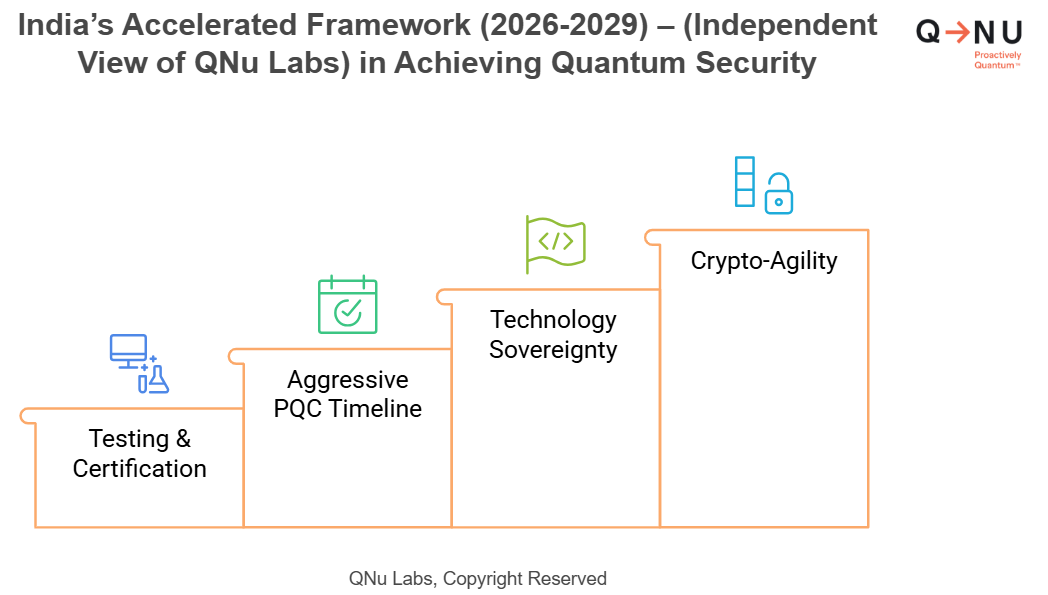
With the world’s fastest-growing digital economy, India recognises quantum security as survival, not just protection. Under the National Quantum Mission (₹6,003.65 crore through 2030-31 DST India, 2023), India’s strategy must compress decade-long timelines into a focused three-year implementation.
Pillar 1: Testing & Certification Four-tier assurance (L1-L4) with Level 4 prioritising indigenous implementations for sovereign assurance. Enables sector regulators to enforce quantum-safe standards.
Pillar 2: Aggressive PQC Timeline
Pillar 3: Technology Sovereignty Progressive adoption of indigenous solutions. Public Procurement Order 2019 applies to quantum-safe products. QNu Labs (qnulabs.com) – One of the Top QKD Companies and Top PQC Companies globally, incubated at IIT Madras, demonstrates indigenous innovation that meets world-class standards with proven defence, enterprise and critical infrastructure deployments.
Pillar 4: Crypto-Agility Organisational capacity for rapid algorithm swapping. Cryptography fails definitively—not gradually. Transforms migration from a one-time project to an enduring capability.
Q1: Do we have a complete cryptographic inventory? You cannot protect what you cannot see. Start with cryptographic discovery today – of your applications, keys, algorithms, databases, IoT, vendors, and cloud.
Q2: Which systems need 10+ year confidentiality? If adversaries harvest today, will data be sensitive in 2036? Financial records, R&D, and government communications demand immediate migration.
Q3: What’s our vendors’ quantum-safe roadmap? Demand Cryptographic Bills of Materials (CBOMs). Build contractual obligations. Vendor gaps are supply chain risks – address now.
Q4: Can architecture support rapid algorithm changes? True crypto-agility requires modular design, extensibility, and tested rollback. If changing encryption takes months, you lack quantum-era agility.
Q5: Have we evaluated indigenous solutions? Sovereign platforms (qnulabs.com) offer assured supply chains, national standards alignment, reduced geopolitical risk, and strategic resilience.

Consider the mathematics:
Migration starting in 2026 positions ahead of the quantum curve. Starting 2028? Racing Q-Day with half the time. Starting 2030? Managing crisis, not strategy.
India’s 2026-2029 roadmap recognises this reality. The question isn’t whether your organisation needs quantum security; it’s whether you’ll lead the transition or scramble when quantum breaks RSA in production.
QNu Labs, India’s pioneering quantum security company incubated at IIT Madras Research Park, offers comprehensive solutions aligned with the National Quantum
Mission:
Proven deployments: Indian Navy, Army, MCTE, MCEME, BSNL, and enterprise customers across 25+ sectors globally. Backed by 11+ patents, 400+ trained officers, and 500+ km of protected networks.
Explore Solutions | Read Case Studies | Contact Experts
Let’s build your quantum-safe future before time runs out.