
Are You Ready to Witness the Future of Data Security?
Platform
Resources
©2026 QuNu Labs Private Limited, All Rights Reserved.

Fraud-as-a-Service has turned digital crime into a monthly-fee business, putting deepfakes and phishing kits in anyone's hands. The defence is not sharper vigilance. It is a foundation of trust that cannot be rented, stolen or faked.
For roughly the price of a music streaming plan, a person with no technical skill can now rent everything needed to impersonate your executives, drain your customers' accounts and forge a way through your onboarding checks. Cybercrime has quietly reorganised itself along the same lines as the software industry it preys on: recurring fees, product tiers, customer support and regular updates. The barrier that once kept most criminals out, technical skill, has been removed and packaged as a service. For the businesses on the receiving end, the question is no longer whether an attacker is sophisticated. It is whether your foundation of trust can survive tools that anyone can buy.
~ Fraud-as-a-Service (FaaS) bundles phishing kits, stolen credentials, deepfakes and money-mule networks into subscriptions starting near fifty dollars a month.
~ By removing the need for skill, FaaS has multiplied the number of attackers and made identity and trust, not the network perimeter, the primary target.
~ Awareness training cannot beat a rented deepfake. Durable defence means anchoring trust in cryptography that attackers cannot fake, predict or steal.
FaaS borrows its playbook from Software-as-a-Service (SaaS): dashboards, documentation, live support over encrypted channels and tiered pricing. Entry tiers supply ready-made lookalike banking and government login pages. Higher tiers add deepfake video and voice cloning built to defeat identity checks. Fuelling all of it, per Group-IB, are uncensored "dark" large language models that produce phishing kits, scam scripts and malicious code without safeguards, generating thousands of tailored lures on demand.
The economics are the point. Subscriptions begin around fifty dollars a month, giving low-skilled actors enterprise-grade phishing kits, mule networks and synthetic identity tools. The losses scale far past that. Juniper Research projects global fraud losses will climb 153 percent, from 23 billion dollars in 2025 to 58.3 billion dollars by 2030. In 2024, the FBI's Internet Crime Complaint Center (IC3) logged 859,532 complaints and a record 16.6 billion dollars in losses, with cyber-enabled fraud responsible for 83 percent of that total. Europol has named fraud the fastest-growing area of organised crime in the European Union.
When skill stops being the gatekeeper, the pool of attackers explodes and the target shifts. Group-IB describes artificial intelligence (AI) as the plumbing of modern cybercrime, turning capabilities that once took talent into services anyone can rent, and points to identity and trust as the new primary attack surface. Deepfakes are the sharpest edge of that shift. Cyble found AI-powered deepfakes in more than 30 percent of high-impact corporate impersonation attacks in 2025, and Sumsub reported deepfake attempts up 94 percent year on year in the UK.
Financial institutions feel it first. IBM reports that bank call centres are being flooded with voice-clone calls designed to slip past voice authentication, that AI-fuelled fraud has become a leading concern for banks, and that finance staff have been manipulated into moving tens of millions through deepfake meetings cloning a chief executive's voice and likeness. These attacks do not break your encryption. They walk through the front door wearing a trusted face.
Regulators are moving to match the threat. The Reserve Bank of India's FREE-AI framework sets out governance, risk-mitigation and assurance expectations for AI adoption across regulated banks, insurers and fintechs. The same regulator has rolled out MuleHunter.AI, an AI and machine-learning model that helps banks detect the mule accounts Fraud-as-a-Service networks depend on, now live across dozens of banks and scaling further. For regulated sectors, defensible cryptography is fast becoming a compliance question, not just a security one.
The same capability now cuts both ways. The United States Cybersecurity and Infrastructure Security Agency (CISA) has begun using Anthropic's Mythos model to audit federal code for vulnerabilities, an effort that has already surfaced a large number of flaws. As QNu Labs' Mythos whitepaper sets out, once that class of model reaches attackers the exploit window collapses from years to hours, which is exactly why encryption becomes the last line of defence.
The instinct is to answer with more awareness training and tighter perimeter controls. Both are necessary, and both are structurally outmatched. Deepfake voice calls are already slipping past authentication, which is why IBM urges detection that is technological and real-time rather than left to human vigilance. FaaS is built to slip past identity checks too. As The Paypers notes, attackers fabricate identities that clear static verification, defeat multi-factor prompts through fatigue and session hijacking, and lean on phishing kits, so defence now demands behavioural and contextual analysis beyond credential checks. The uncomfortable truth is that trust built on something a human can see, hear or type is trust an attacker can now buy the tools to counterfeit.
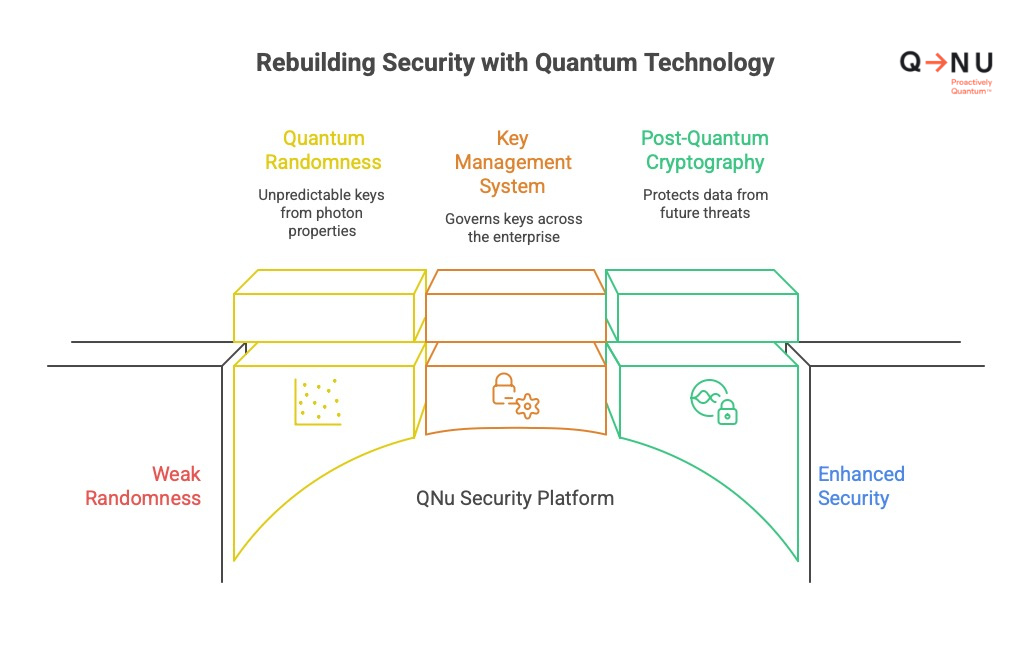
This is the ground QNu Labs was built to hold, and where it stands as the bulwark against an industrialised fraud economy. If crime has commoditised the theft of identity and trust, the durable answer is to move trust to a quantum-safe foundation that cannot be faked, predicted or reused. QNu anchors it in physics, not in secrets a criminal can steal.
It starts with randomness. Quantum random number generation produces keys and one-time tokens drawn from the physical properties of photons, so they are genuinely unpredictable and close the weak-randomness gaps that automated credential and session attacks exploit. Quantum key distribution then makes key generation, distribution and management unhackable between bank headquarters and branches, data centres, and branch to branch, so keys in motion cannot be intercepted or forged. A Key Management System generates and governs those keys across the enterprise, so a single stolen key or credential loses its value instead of unlocking everything. And a layer of post-quantum cryptography, mapped through a clear Cryptographic Bill of Materials, keeps protected data locked even as computing power and criminal tooling grow, so information harvested today cannot be cashed in later.
Don't end up on the wrong side of these numbers.
Book a demo and see how QNu Labs shuts the door Fraud-as-a-Service is built to walk through.