

Are You Ready to Witness the Future of Data Security?
Platform
Resources
©2026 QuNu Labs Private Limited, All Rights Reserved.

The five-year-old assumption that Q-Day was a problem for the 2030s just expired. In a single 12-month window, three research breakthroughs collapsed every comfortable timeline that governments, banks, and infrastructure operators had been presenting to their boards. Here is what changed, who is responding, and why quantum security has become a question of national sovereignty.
For five years, the boardroom answer to quantum risk was nearly identical across industries and continents: we are monitoring it; the threat is real but distant; migration is on the 2032 roadmap.
The year 2026 turned quantum risk from a future discussion into a present infrastructure problem.
In May 2025, Google researcher Craig Gidney published a follow-up to his own widely cited 2019 benchmark and showed that breaking RSA-2048, the encryption sitting underneath most internet banking, signed certificates, and critical communications infrastructure, could be done with fewer than one million physical qubits in under a week. That is roughly 20 times fewer qubits than the 2019 estimate. By March 2026, a joint paper from Google Quantum AI, the Ethereum Foundation, and Stanford suggested elliptic curve cryptography may need fewer than 500,000 qubits to break. Another 20x reduction.
The hardware did not get faster. The algorithms got smarter. And the gap between what exists today and what would be needed to break encryption narrowed in ways risk models had not priced in.
The Quantum Insider has declared 2026 the Year of Quantum Security, with launch events featuring senior officials from the FBI, NIST, and CISA. Google's own internal quantum-secure transition timeline has been pulled forward to 2029. The Global Cybersecurity Forum's flagship report calls proactive migration a board-level mandate. For every organisation sitting underneath a secure network, a financial transaction, or a government communication channel: the question stopped being if. It is now when, and what to deploy first.
There is a broader shift underneath the technical one, and it is accelerating just as fast.
Governments are no longer treating cryptographic security as a vendor procurement problem. They are treating it as a sovereignty question. The ability to protect communications, financial data, and critical infrastructure against adversarial decryption is being placed alongside energy independence and supply chain security as a strategic national asset.
The US has set deadlines through NSA's CNSA 2.0 framework, mandating quantum-resistant algorithms for all national security systems by 2027. The EU's NIS2 directive and the European Cyber Resilience Act are pushing quantum readiness into regulatory compliance for critical infrastructure operators. National quantum missions in India, Singapore, the UK, France, Germany, and Australia are funding domestic deployment directly, not waiting for market forces to move.
The logic is consistent across every region. A country whose communications infrastructure depends entirely on cryptographic standards it did not develop, and cannot independently replace, carries a structural vulnerability. The quantum transition is the moment many governments have chosen to close it.
QNu Labs, India's first quantum cybersecurity company represents exactly this model. Built and deployed entirely on indigenous technology, QNu's infrastructure already includes a 1,000 km QKD network under the National Quantum Mission, one of the longest QKD deployments in the world, engineered for underground and underwater fibre routes. Sovereign development and production-scale deployment, not theoretical capability.
Explore how QNu secures critical infrastructure across banking, government, and enterprise.
In Europe, regulation is ahead of deployment, but the gap is closing. France's ANSSI, Germany's BSI, and the UK's NCSC have all issued post-quantum migration guidance aligned with NIST's 2024 standards. The EuroQCI initiative, with 26 member states now deploying national quantum communication networks, is building the continent-wide backbone targeting full operation by 2027. On the ground, Deutsche Telekom, BT, and Telefonica all ran live quantum security deployments in 2025 and 2026. Compliance will drive adoption here. The question is whether deployment speed matches the mandate timeline.
In Asia and Australia, policy has given way to execution. Singapore made quantum a formal pillar of its S$37 billionResearch, Innovation and Enterprise 2030 strategy, with the National Quantum-Safe Network already trialling quantum-safe communications. Australia and South Korea are accelerating, and a GSMA survey found 60% of operators globally have quantum on their roadmap, with 12% planning deployment within 12 months. Execution has replaced conversation.
In the GCC and emerging markets, the approach is more aggressive than most expect. Saudi Arabia's Vision 2030blueprint explicitly positions quantum as a tool for strategic autonomy, with NEOM and KAUST's quantum foundry already in execution. The UAE's National Encryption Policy incorporates post-quantum cryptography controls, and new regional infrastructure is being designed with quantum-safe requirements built in from the ground up. For parts of the continent where backbone infrastructure is still being laid, the opportunity to build quantum-safe architecture at foundation rather than retrofit it later remains open. That window is narrower than it appears
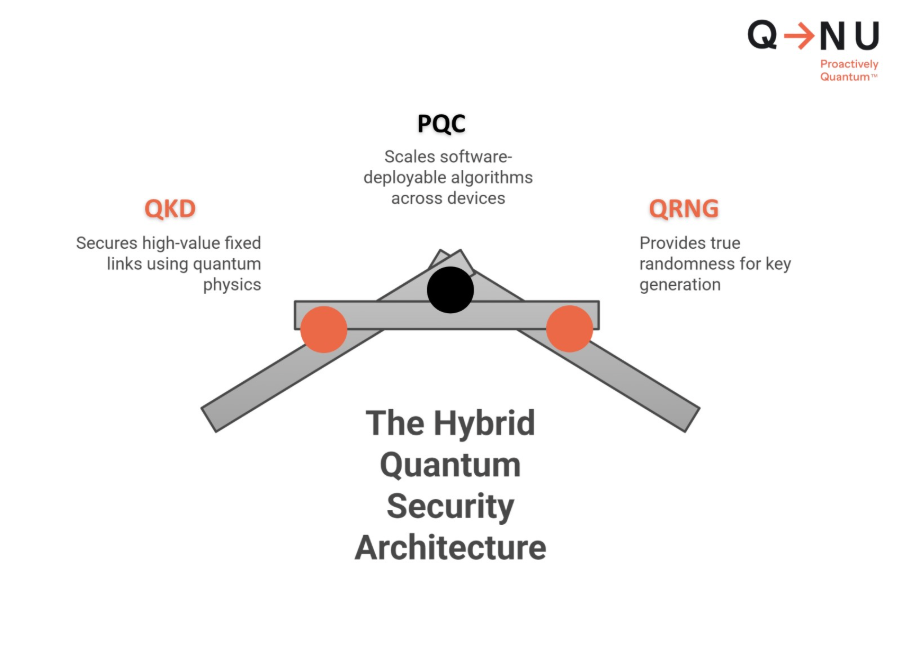
QShield is built on exactly this. The choice is not QKD versus PQC. Every major regulator, from NIST to NCSC to ANSSI to CRYPTREC, recommends the same answer: Hybrid.
QKD secures keys using physics. Any interception disturbs the photon state and triggers immediate detection, making it the right architecture for government communications, interbank settlement, data centre interconnects, and critical infrastructure. Researchers at the Niels Bohr Institute have demonstrated coherent single-photon emission in the 1300 nm fibre band, removing one of QKD's last significant commercial obstacles.
PQC does the rest. NIST finalised three post-quantum standards in August 2024, software-deployable across servers, IoT endpoints, FPGAs, and cloud platforms without new hardware, provided organisations have crypto-agility: the ability to swap algorithms without rewriting applications.
QRNG sits underneath both. Every key is only as strong as the randomness seeding it. Classical pseudo-random generators are deterministic. QRNG produces true randomness from quantum optical processes that cannot be predicted or repeated.
Hybrid is not a compromise. Quantum physics where it fits, advanced mathematics where it scales, true randomness underneath both. The deployment race is on.
The strategic answer is settled. The operational answer is not.
Cryptography is buried across more systems than most security teams have inventoried. TLS, certificates, PKI, signed firmware, SSH, IoT credentials, identity systems, partner integrations, and vendor products without crypto-agility roadmaps. A complete Cryptographic Bill of Materials for a large organisation can take a year of dedicated work. After inventory comes vendor coordination, testing, validation, and phased rollout across systems not designed for algorithm agility.
Most migration plans on paper today extend into 2030 or beyond. The 2026 timeline acceleration made those plans dangerously optimistic.
There is also a threat that does not wait for migration plans to complete. Adversaries do not need a cryptographically relevant quantum computer today to cause damage. They are already running Harvest Now, Decrypt Later: intercepting encrypted traffic now and storing it until Q-Day arrives. For data with 10, 20, or 30-year confidentiality requirements, the harvest pipeline is already running. The organisations navigating the next 18 months well are not the ones with the most ambitious roadmap. They are the ones who have already started.
Inside one of Asia's largest networks, the hybrid stack, QKD, PQC, and QRNG operating together, is already running in production. Not a sandbox. Not a pilot. Customer-facing infrastructure carrying real traffic.
The deployment ran on existing fibre. Classical traffic continued uninterrupted. Crypto-agility was built into the architecture so future algorithm changes do not become application rewrites. Operations teams kept their existing workflows, and the organisation got a quantum-safe network without a quantum-sized integration bill.
It is today one of the few production references globally where every layer of the hybrid quantum architecture is operational at scale, and one of the clearest answers to the question every CISO is now being asked: What does quantum-safe infrastructure actually look like when it works?
See how the deployment was architected and delivered.
Three things are true at once. The threat has accelerated by a measurable, peer-reviewed margin. The architecture that addresses it is settled across every major regulatory body. And the deployment runway has not shortened to match.
Organisations that begin in 2026 still have time for measured rollouts and the cost flexibility of early movers. Those that wait will migrate in 2028 and 2029 against tighter deadlines, scarcer talent, and compliance pressure already entering procurement terms.
The quantum security shift is no longer a question of when it becomes relevant.
The only question is which side of it you want to be on: Start your quantum-safe migration roadmap.