


Are You Ready to Witness the Future of Data Security?
Platform
Resources
©2026 QuNu Labs Private Limited, All Rights Reserved.

~ Hybrid cryptography runs classical and post-quantum algorithms in parallel on the same session — for TLS, this typically means hybrid ML-KEM-768 + X25519 key exchange — so an attacker must break both algorithms to compromise the connection.
~ Hybrid post-quantum key exchange isn't experimental anymore: a preliminary variant of Kyber has already been deployed in TLS 1.3 by Google Chrome and Cloudflare in hybrid mode.
~ A gap most enterprises miss: hybrid key exchange only protects the encrypted channel — when a browser loads a site over X25519MLKEM768, the session key is post-quantum-secure, but the server certificate that authenticated the handshake is still signed with ECDSA or RSA, leaving certificate-based authentication exposed even after "going hybrid."
~ Achieving full end-to-end quantum security requires migrating both key exchange mechanisms and certificate infrastructures — not just one or the other.
~ Hybrid rollout is now the dominant PQC migration pattern for 2026 precisely because it preserves compatibility while reducing quantum risk, rather than forcing an all-or-nothing cutover.
Hybrid cryptography is a security approach that combines classical cryptographic algorithms — like ECDH and RSA — with post-quantum algorithms — like ML-KEM and ML-DSA — within the same protocol session, so that both must be broken for an attacker to succeed. Rather than choosing between "trusted but quantum-vulnerable" and "quantum-safe but newer and less battle-tested," hybrid cryptography runs both simultaneously, giving enterprises quantum resistance without abandoning the proven track record of algorithms that have secured the internet for decades.
The dominant migration pattern for 2026 is hybrid rollout, because pure PQC everywhere, all at once, sounds elegant in a conference talk and is deeply disruptive in a production environment.
Hybrid cryptography exists specifically as a bridge strategy for post quantum cryptography adoption — it lets enterprises introduce quantum-resistant protection today without waiting for every client, library, and dependency in their estate to catch up. Classical cryptography is well-supported everywhere; PQC algorithms are newer, larger, and not uniformly supported — real systems need a path that works across modern clients, older clients, middleboxes, proxies, load balancers, SDKs, and managed services. That path is hybrid.
In a hybrid TLS handshake, the client and server derive their shared session key from two independent sources at once. The IETF hybrid key exchange draft specifies the X25519+ML-KEM-768 composite key agreement for TLS 1.3 — the client sends both an X25519 ephemeral public key and an ML-KEM-768 encapsulation key in the ClientHello message, and the server responds with both an X25519 public key and an ML-KEM-768 ciphertext. The specific construction is now standardised: the first variant is the concatenated hybrid KEM defined for TLS 1.3 in RFC 9794 (published December 2024) and instantiated as X25519MLKEM768, with the two secrets combined through a key derivation function so the resulting session key depends on both.
This isn't a lab experiment. Industry tests have moved from early CECPQ experiments combining classical ECDH with post-quantum KEMs through to production deployment, and Akamai rolled out post-quantum cryptography support in its Ghost to Origin connections using TLS 1.3 hybrid key exchange in mid-2025, specifically to protect against harvest-now-decrypt-later attacks on origin traffic.
Hybrid cryptography isn't limited to combining two mathematical algorithms — it can also combine PQC with QKD, pairing software-deployable post-quantum algorithms across the broad enterprise estate with physics-based quantum key distribution on the specific highest-value links where the investment in dedicated hardware is justified. This layered model means an enterprise isn't betting its entire security posture on one class of defence — a weakness discovered in a PQC algorithm doesn't touch QKD-protected links, and QKD's hardware constraints don't limit protection everywhere else.
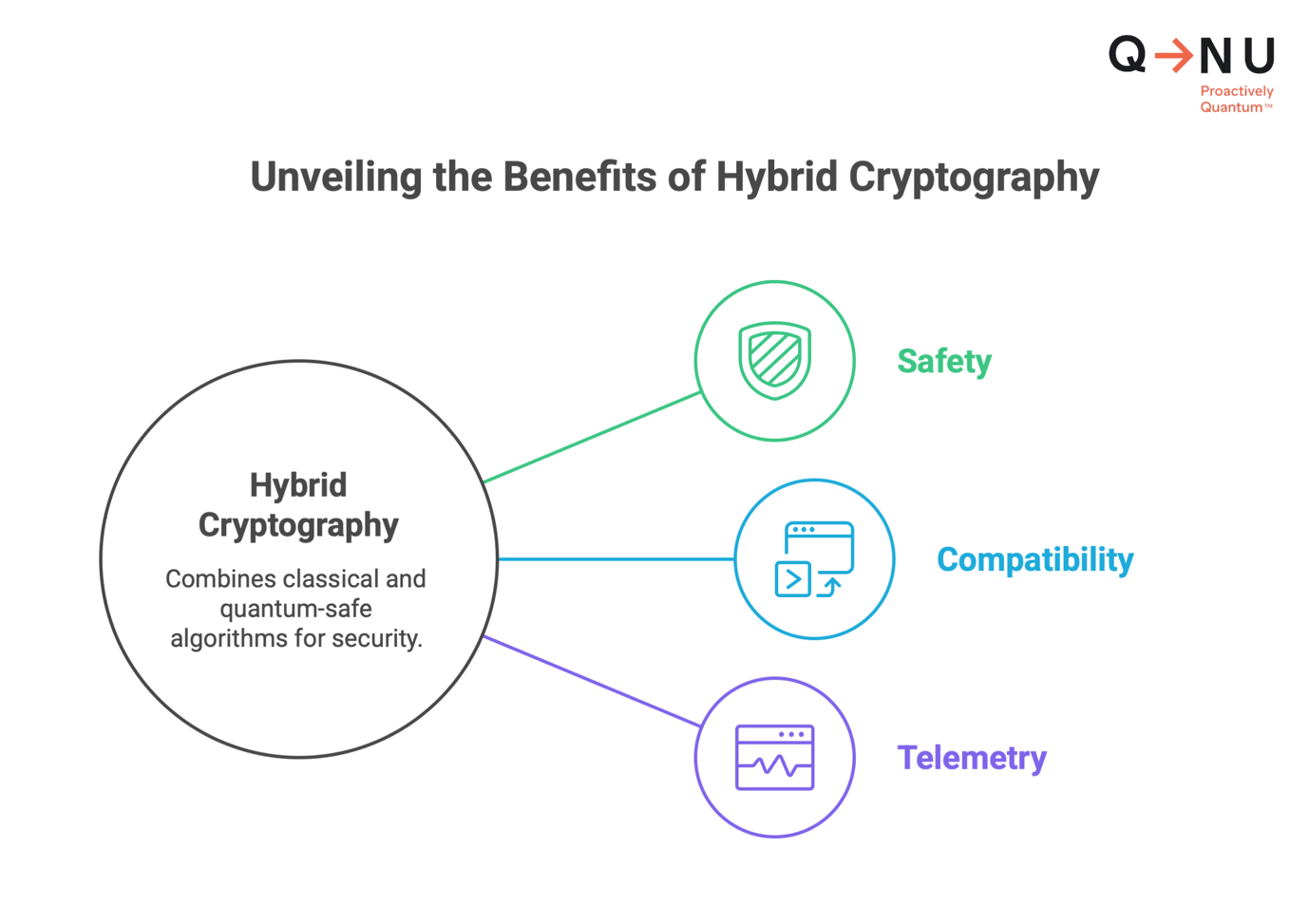
In a hybrid design, the session remains secure if either the classical or quantum-safe component holds up, which directly de-risks migration in three concrete ways:
For enterprises cybersecurity teams, this matters because a failed all-or-nothing PQC cutover doesn't just delay a migration — it can take down live customer-facing services. Hybrid deployment turns a high-stakes binary switch into a measured, reversible rollout.
Hybrid cryptography works best alongside genuine crypto-agility — the ability to swap or reconfigure algorithms without rewriting application logic. Systems built with algorithm-agile design abstract signing and key exchange operations behind interfaces that can be swapped, with algorithm selection as an explicit, version-controlled configuration parameter rather than something hard-coded into the application. This is what makes phased adoption realistic: an enterprise can move internal systems to hybrid first, expand to customer-facing TLS next, and update certificate signing last — each phase a configuration change rather than a rebuild.
A concrete phasing example enterprises are using in 2026: internal mTLS moving to roughly 50% composite certificate adoption by end of 2026, code-signing targeting 100% composite by mid-2027, and public-facing TLS leaf certificates remaining classical until CA/Browser Forum baseline policy permits otherwise. Measuring progress by percentage of production traffic actually using hybrid algorithms — not just whether a pilot exists — is what separates real readiness from a proof-of-concept nobody has scaled.
Hybrid cryptography and quantum cryptography solve related problems in fundamentally different ways, and conflating them creates real gaps in enterprise security planning. Hybrid cryptography combines two classical-and-post-quantum mathematical algorithms, both running on ordinary computers — no quantum hardware involved anywhere in the process. Quantum cryptography, and specifically QKD, uses the physical behaviour of quantum particles to distribute keys, requiring dedicated photonic hardware and fibre infrastructure. A hybrid TLS connection using X25519 + ML-KEM is entirely software-based; a QKD link secured by the laws of quantum mechanics is not. Enterprises evaluating "quantum-safe" vendor claims should ask specifically which category a solution falls into — the difference determines cost, deployment complexity, and what kind of security guarantee is actually being offered.
The gap most teams miss: a hybrid TLS handshake can make the session key fully post-quantum-secure while the server certificate that authenticated that handshake is still signed with ECDSA or RSA — meaning the connection is encrypted against future quantum decryption, but the identity assurance behind it isn't. Achieving genuine end-to-end quantum security requires migrating both key exchange and certificate-based authentication, not treating hybrid key exchange alone as "done."
QNu Labs is the world's only full-stack quantum cybersecurity company, and hybrid deployment is central to how we help enterprises migrate without disrupting live systems. Our Quantum Safe Key Lifecycle Management Systems (QKMS) support hybrid classical-PQC key exchange and certificate models across TLS, VPN, and code-signing infrastructure, while our QKD capabilities — validated over real-world fibre networks under India's National Quantum Mission — protect the specific high-value links where physics-based security is worth the investment. Incubated at IIT Madras Research Park, we help banking, defence, and telecom organisations sequence hybrid adoption as part of a complete quantum readiness assessment, covering both the key exchange layer and the certificate authentication layer that most migration plans overlook.