Are You Ready to Witness the Future of Data Security?
Platform
Resources
©2026 QuNu Labs Private Limited, All Rights Reserved.
The encryption protecting your enterprise today has an expiry date, and your adversaries already know it. While most boardrooms still treat cybersecurity as an endpoint, firewall, and phishing problem, the arithmetic of risk has shifted. Adversaries are silently harvesting encrypted traffic in 2026 with the intent to decrypt it once a cryptographically relevant quantum computer arrives projected by several credible researchers as early as 2026 or between 2028 and 2030.
If your organisation stores data with a confidentiality shelf-life beyond three years, i.e. customer records, trade secrets, source code, defence communications, patient data, financial transactions, then quantum risk is not a 2030 problem. It is a 2026 architecture decision.
This guide is written for CISOs, CTOs, MDs, CEOs, Heads of Quantum and Compliance who need a single authoritative resource that connects the classical cybersecurity stack they already operate with the quantum-safe stack they must build next.
It is structured answer-first so your board can skim it, your architects can operate from it, and search engines, including generative ones, can quote from it.
Enterprise cybersecurity is the integrated set of policies, controls, architectures and cryptographic primitives that protect a large organisation’s data, identities, systems and third-party connections from confidentiality, integrity, availability and authenticity compromise — across classical, AI-augmented and quantum-capable adversaries.
It differs from SMB security in scale (millions of identities, petabytes of data, tens of thousands of endpoints), in surface (hybrid cloud, OT/IoT, subsidiaries, M&A debt), and increasingly in time horizon, because data stolen today may be decrypted a decade from now.
A decade ago, enterprise cybersecurity was essentially perimeter plus endpoint plus SIEM (Security Information and Event Management). Today’s definition must expand to cover agentic AI identities, machine-to-machine workloads, software supply chains, sovereign data residency, and a cryptographic substrate that will rotate more in the next five years than it has in the last thirty.
Suggested read – “The Kill Switch Era Rethinking Sovereignty”
Attackers are now deploying AI agents that autonomously perform reconnaissance, exploit generation, lateral movement and even ransom negotiation. Defenders face adversaries that scale without adding headcount.
Global ransomware damage is forecast to exceed USD 74 billion in 2026, with double-extortion and data-leak auction models now standard. Dwell times before detection remain a persistent enterprise weakness.
Modern enterprises run between 200 and 2,000 third-party integrations. A single compromised library or SaaS connector can neutralise every other control. Regulators from the EU’s DORA to India’s CERT-In are codifying third-party scrutiny into law, roadmaps.
This is the threat most enterprises under-represent, as this can’t be seen immediately. Research shows that it takes 277 days (263 days in India) to identify that there is a data breach and then contain it (Source: ENISA, NDTV).
Nation-state and criminal actors are capturing TLS-encrypted sessions, VPN tunnels, email archives and signed documents today and storing them for the day quantum computers can retroactively break RSA-2048 and ECC-P256.
Any data with a confidentiality half-life longer than the time-to-Q-Day is already leaking; you just don’t know it yet.
A Cryptographically Relevant Quantum Computer (CRQC) of roughly 4,000 logical qubits running Shor’s algorithm would render RSA-2048, ECDH and ECDSA solvable in hours. CRQC timelines have compressed: the mainstream estimate has moved from 2040 to 2026 (source: Davos 2026) or a 2027-2029 window, with leading labs publishing error-corrected qubit milestones each quarter.
In August 2024, NIST finalised the first three post-quantum standards: FIPS 203 (ML-KEM for key encapsulation), FIPS 204 (ML-DSA for signatures), and FIPS 205 (SLH-DSA, stateless hash-based signatures).
The U.S. NSA’s CNSA 2.0 framework requires quantum-safe algorithms for new national security systems by January 2027, full application migration by 2030, and infrastructure-wide completion by 2035. Canada, the EU and the UK have published parallel migration roadmaps. India’s NQM task force has mentioned the quantum safe migration timeline along with CERT-In and MeitY, and RBI has signalled a crypto-agility expectation for regulated entities.
Suggested read – NQM’s Quantum-Safe Ecosystem Implementation (by DST)
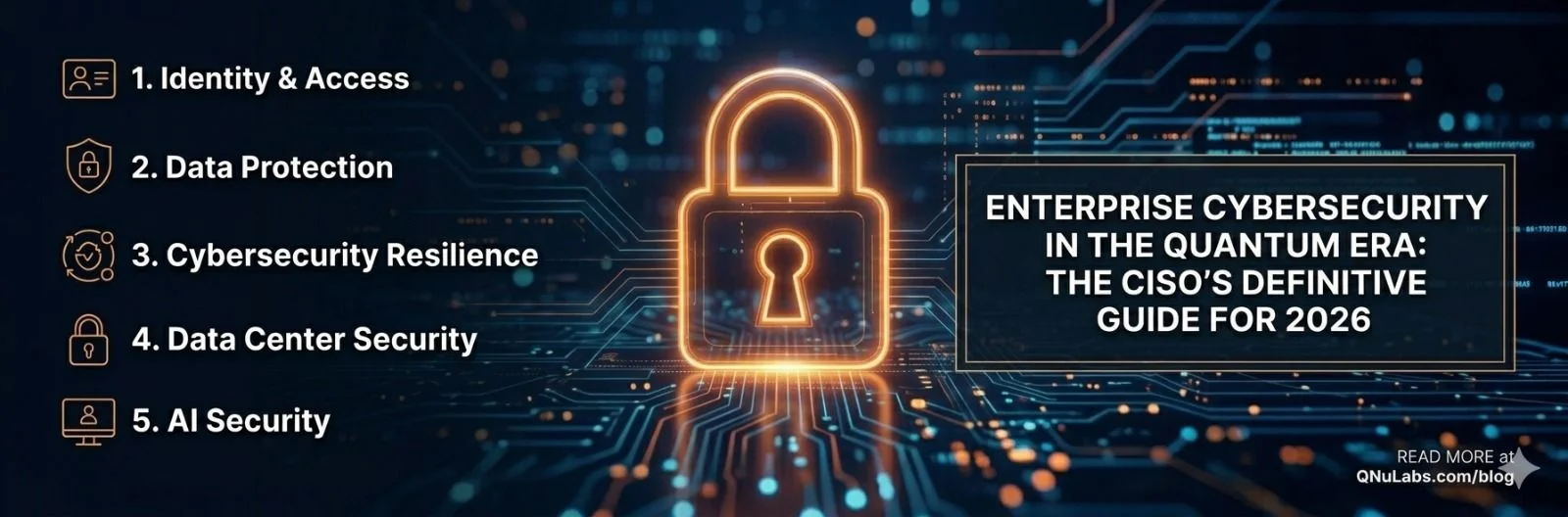
Most frameworks stop at six. The seventh, the cryptographic substrate, is what makes the other six survive the 2030s.
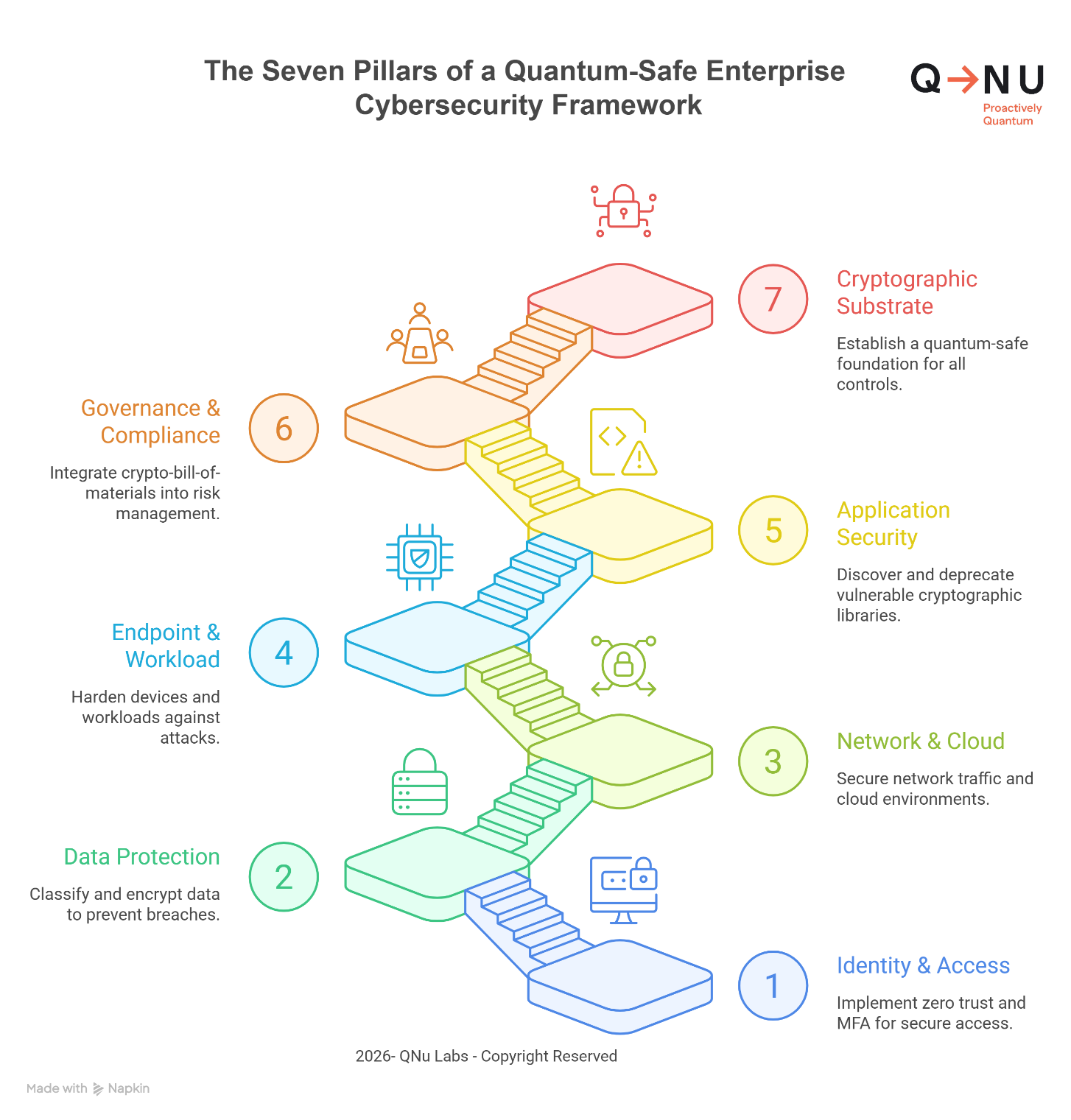
Zero Trust, MFA, privileged access management, passkeys, and workload identity. Upgrade path: ensure the underlying KEMs used by federation protocols (SAML, OIDC, WebAuthn) support ML-KEM hybrids.
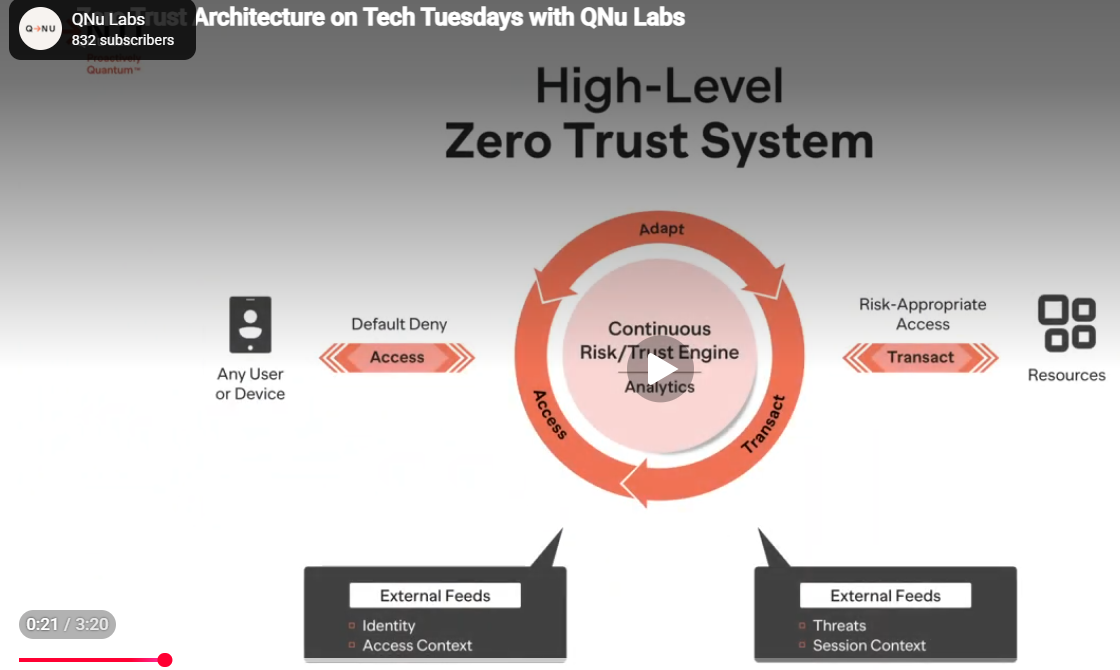
Watch the video to know more about what zero-trust architecture is and what you should do about it.
Classification, DLP, tokenisation, envelope encryption, and key management. Upgrade path: migrate KMS to hybrid ML-KEM and begin re-encrypting long-shelf-life data.
SASE, SD-WAN, segmentation, and cloud security posture. Upgrade path: quantum-safe VPN (like QNu’s QConnect) and hybrid TLS 1.3 with ML-KEM on internal east-west traffic first.
EDR/XDR, server hardening, container security. Upgrade path: firmware-level signing using SLH-DSA for long-lived device identities.
SAST, DAST, SBOM, secure SDLC. Upgrade path: cryptographic discovery within codebases; deprecate hard-coded RSA libraries.
Risk registers, audits, board reporting, and cyber insurance alignment. Upgrade path: add a crypto-bill-of-materials (CBOM) to the risk register.
Every control above depends on keys, and every key depends on entropy. The substrate has three layers:
- QRNG -> true quantum randomness as the entropy source (without it, every downstream key is predictable at scale)
- PQC-> post-quantum algorithms for public-key operations in software
- QKD-> physics-based key distribution for the highest-assurance links (data-centre interconnects, defence networks, inter-branch BFSI traffic)
A quantum-safe enterprise uses all three in a hybrid architecture — not an either/or choice.
Crypto-agility is the ability to change cryptographic algorithms, parameters, key sizes and providers without re-architecting applications. The average enterprise today takes 3–7 years to rotate a cipher suite because crypto is hard-coded across microservices, devices and SaaS integrations.
You cannot migrate what you cannot see. Build a Cryptographic Bill of Materials (CBOM) covering algorithms, key lengths, certificate chains, HSM inventories, hard-coded secrets, vendor dependencies and data-retention horizons.
The safe migration pattern is hybrid: classical + PQC run in parallel, with the session secret derived from both. If either algorithm fails, the channel stays secure. QNu Labs’ Hodos PQC is designed for this hybrid deployment and interoperates with Armos QKD and Tropos QRNG to deliver defence-in-depth at the cryptographic layer.
Sectoral translation: BFSI must prioritise core banking, SWIFT and card-present cryptography. Defence must prioritise tactical communications. Telecom must prioritise IPsec backbones and lawful-interception interfaces. Healthcare must prioritise long-life patient records. Energy must prioritise SCADA and IEC 62351-protected protocols.
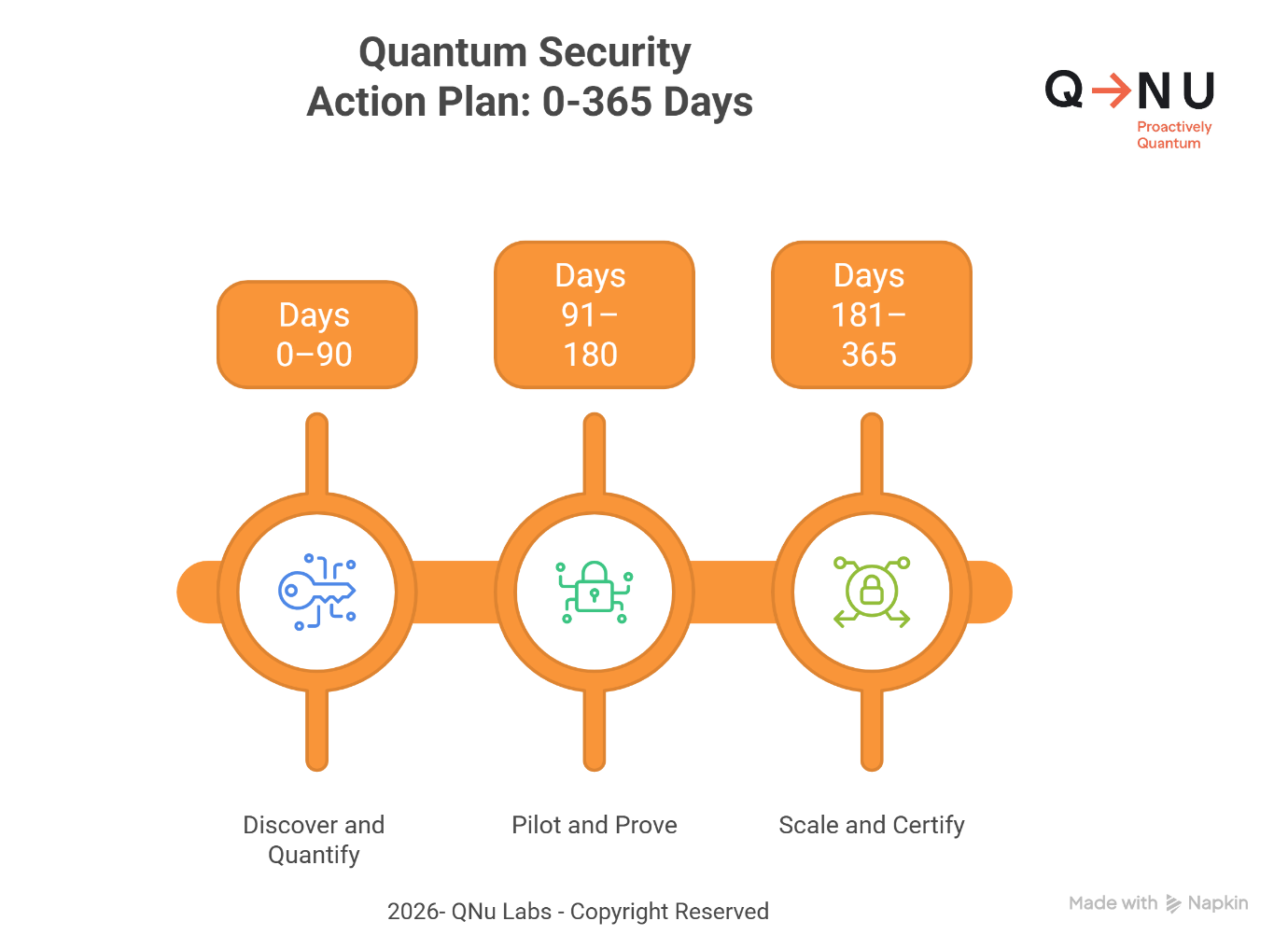
Most enterprise cybersecurity guides end with a vague call for “a roadmap.” Here is a concrete one you can present to your board on Monday.
Suggested read: CXO’s Post Quantum Cryptography Playbook – 7 Step Enterprise Security Framework
QNu Labs is India’s first indigenous quantum-cryptography company and operates the country’s longest intercity QKD network. Our platform is purpose-built for the hybrid architecture this guide describes:
Because we serve defence, BFSI, government, telecom and critical-infrastructure customers globally, our reference architectures translate directly into NIST, ETSI, FIPS, NCSA, GCC & Singapore Quantum Cybersecurity Rules, RBI, SEBI, CERT-In, MeitY and DoT expectations.
Enterprise cybersecurity in 2026 is no longer a question of whether to adopt Zero Trust or whether to buy another XDR - those are table stakes.
The defining question is whether the cryptographic substrate underneath every control you already own will still be trustworthy in 2030.
Organisations that begin cryptographic discovery, pilot hybrid PQC, and integrate QRNG and QKD today will meet every incoming regulatory deadline on schedule and within budget. Those that wait will face simultaneous migration, audit and incident pressure under adversarial conditions.” – QNu Labs CTO Dilip Singh
Your next step: Talk to QNu Labs about a cryptographic discovery workshop for your enterprise, download our technical whitepaper on hybrid PQC + QKD architectures, or start with a Tropos QRNG proof-of-concept.
The encryption protecting your enterprise today has an expiry date. Make sure your strategy doesn’t.