Are You Ready to Witness the Future of Data Security?
Platform
Resources
©2026 QuNu Labs Private Limited, All Rights Reserved.

~ HSMs are where your most sensitive keys are generated, stored, and used. If they can't run post-quantum algorithms, your PQC migration stalls at the root of trust.
~ ML-KEM (FIPS 203) and ML-DSA (FIPS 204) are now fully integrated into mainstream HSM firmware, so PQC HSM capability is a present-day procurement question, not a future one.
~ A critical gap most enterprises miss: vendors have CAVP certification for PQC algorithms and FIPS 140-3 Level 3 validation for their modules, but none have yet obtained both together, so "PQC-ready" claims need careful scrutiny.
~ PQC's larger keys and signatures create real memory, performance, and integration impacts on HSM estates - plan for them before migration, not during.
~ Start with a cryptographic inventory, confirm your HSM vendor's PQC firmware and validation roadmap, and pilot hybrid operations before any production cutover.
Every post-quantum migration plan eventually runs into the same physical bottleneck: the hardware security module. You can update TLS libraries, reissue certificates, and rewrite key exchange logic in software, but if the tamper-resistant hardware that generates and guards your root keys can't execute ML-DSA or ML-KEM, the migration stops there. 2026 is shaping up to be a year of unusual HSM movement, and the reason is post-quantum cryptography, leading vendors have shipped firmware that brings NIST's post-quantum algorithms directly into the module, prompting organisations to reassess platforms, consolidate estates, and in some cases migrate between vendors.
A PQC HSM is a hardware security module capable of generating, storing, and performing cryptographic operations with NIST-standardised post-quantum algorithms, ML-KEM (FIPS 203) for key encapsulation, ML-DSA (FIPS 204) for digital signatures, and SLH-DSA (FIPS 205) as a hash-based signature alternative, alongside the classical RSA and ECC operations enterprises still depend on during transition. The HSM's role doesn't change in the post-quantum era: it remains the tamper-resistant root of trust where the most sensitive keys live and never leave. What changes is the mathematics it must execute, and the certification, memory, and performance profile that comes with it.
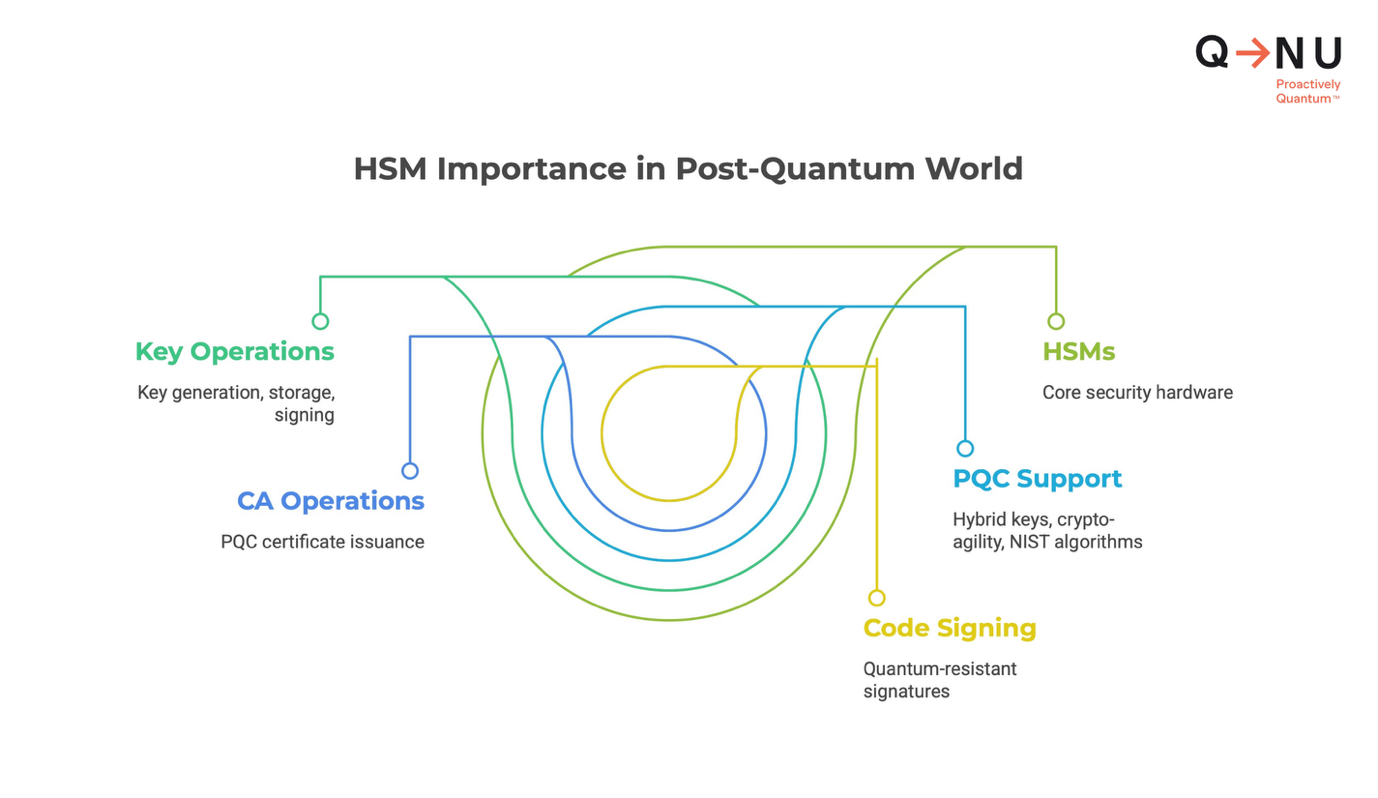
HSMs are especially important because they secure key generation, storage, and signing operations, and PQC-ready platforms increasingly need support for hybrid keys and certificates, crypto agility, and the new NIST algorithms. Every PQC certificate your CA issues, every quantum-safe code-signing operation, and every hybrid TLS key exchange ultimately traces back to a key that should be generated and held inside an HSM. If that hardware can't handle the new algorithms:
Software libraries can implement PQC algorithms, but software-held keys lack the physical protection, tamper resistance, and compliance standing that regulated industries require. PQC certificates do not need new hardware to be safe, but they do need HSMs that support ML-DSA and ML-KEM — and for organisations under FIPS, CNSA 2.0, or sector-specific mandates, hardware-backed key custody isn't optional. A software-only PQC rollout that leaves root keys in software effectively downgrades your security posture while upgrading your algorithms.
The new PQC algorithms carry materially larger keys and signatures than the RSA and ECC operations HSMs were designed around — ML-DSA signatures run to several kilobytes against a few hundred bytes for ECDSA. This is why modern PQC-capable HSMs advertise large amounts of memory inside the crypto module to support growth to larger key sizes, and CPU capabilities that support new, compute-intensive algorithms. Two additional algorithm families matter here that most PQC HSM discussions skip:
Larger signatures mean larger certificate chains, heavier TLS handshakes, and more compute per operation. For high-throughput environments — CA issuance at scale, code-signing pipelines, payment switches — enterprises should benchmark PQC operations on their actual HSM firmware under production-like load before committing to cutover dates. The performance and key-format changes that PQC brings give organisations a natural reason to re-evaluate the platform their root of trust runs on — which is why some teams are treating the PQC refresh as an opportunity to consolidate or modernise their entire HSM estate rather than patch it piecemeal.
Confirm native firmware support for ML-KEM, ML-DSA, and SLH-DSA — fully integrated into firmware, eliminating the need for external functionality modules — plus LMS/HSS if firmware signing under CNSA 2.0 applies to you. Then scrutinise validation status carefully, because this is where marketing and reality diverge. As of late 2025, several vendors have obtained CAVP certification for the PQC algorithms, and several hold FIPS 140-3 Level 3 CMVP validation for their HSMs — but none have yet obtained FIPS 140-3 Level 3 with PQC support combined, with all currently at the Modules in Process or Implementation Under Test stage. The CMVP validation process takes more than two years on average from lab submission to certification, with final approvals expected in 2026 or 2027. If your compliance regime requires validated PQC operations specifically, ask vendors for their submission dates and queue position — not just a "PQC-ready" badge.
An HSM that supports PQC algorithms but doesn't integrate with your certificate lifecycle management, key management system, and CA software creates an island, not a migration path. Verify that your post quantum cryptography solution stack — CA platforms, CLM tools, signing services — can actually invoke the HSM's PQC operations through the interfaces (PKCS#11, KMIP, REST) your applications already use.
Adopt post-quantum cryptography using hybrid operations that combine classical (RSA/ECC) and PQC algorithms so production systems keep working throughout the transition. And if the PQC refresh prompts a vendor change, treat it with the seriousness it deserves: migrating keys between HSM platforms is one of the highest-stakes operations a cryptography team can undertake — done well, it is invisible; done poorly, it can break signing services, invalidate a root of trust, or leave key material in a non-compliant state.
QNu Labs is the world's only full-stack quantum cybersecurity company, and hardware-anchored trust sits at the centre of how we approach PQC migration. Our Quantum Safe Key Lifecycle Management Systems (QKMS) integrate with PQC-capable HSM estates to unify key generation, storage, rotation, and policy across classical and post-quantum algorithms — while our quantum random number generation brings physics-grade entropy to the keys those HSMs produce. Backed by India's National Quantum Mission and incubated at IIT Madras Research Park, we help banking, defence, and telecom organisations sequence HSM readiness within a complete quantum readiness assessment, so the root of trust is upgraded deliberately rather than discovered as a blocker mid-migration.