Are You Ready to Witness the Future of Data Security?
Platform
Resources
©2026 QuNu Labs Private Limited, All Rights Reserved.
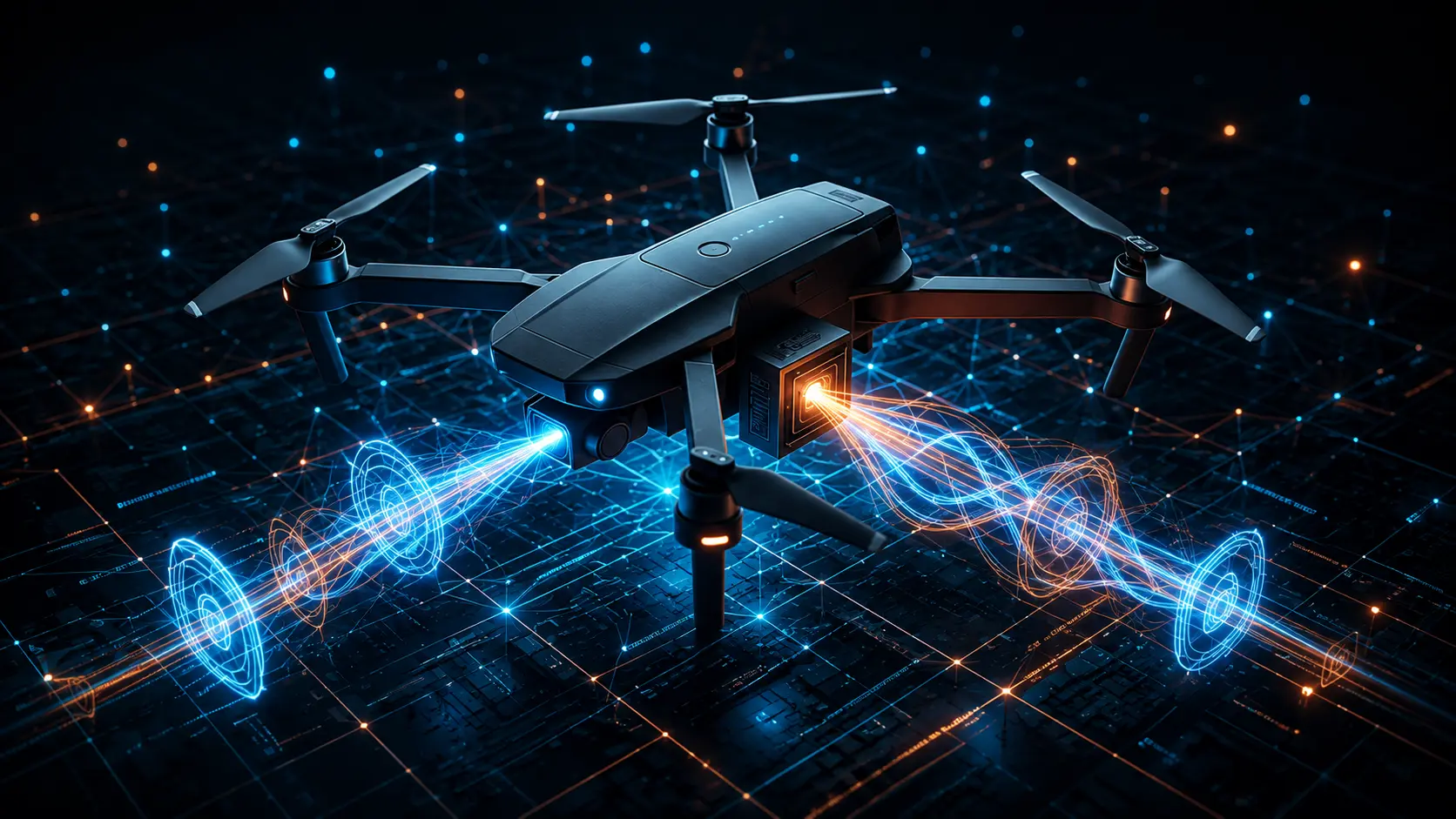
Quantum security for drones means replacing RSA and ECC across every subsystem, command and control, IFF, telemetry, firmware, GNSS and anti-jam hopping, with post-quantum cryptography, quantum random number generation and sovereign key management, before a fleet's migration timeline collides with the quantum computing arrival window.
A drone flying today on RSA and ECC is carrying a security debt that comes due the day a cryptographically relevant quantum computer exists, and adversaries are not waiting for that day to start collecting. Intercepted telemetry, imagery and key exchange traffic are being warehoused now under a harvest now, decrypt later strategy that NIST and the NSA cite as the reason migration cannot wait. According to the Global Risk Institute's 2025 Quantum Threat Timeline Report, the probability of a cryptographically relevant quantum computer within ten years now stands at 28 to 49%, the highest estimate the report has published. A drone fielded today flies for a decade or more. This paper sets out why a platform is only as quantum-safe as its weakest subsystem, including the two most often left out of the conversation: the IFF handshake and the anti-jam hopping sequence.
A 14-page strategic analysis by Rajesh Kumar Krishnan, Senior VP, Innovation at QNu Labs, built for drone OEMs, defence procurement teams, UAS programme leads and export compliance officers. It deliberately skips implementation mechanics. The argument is rationale, requirement and urgency: what has already gone wrong on classical crypto, what a quantum break does to each subsystem, and what a drone company must put in its requirements baseline today.
Cryptographer Michele Mosca's Inequality Has Already Been Failed
If drone mission data must stay secret for 10 to 15 years, and migrating a fielded fleet takes 5 to 8 years, then even a quantum computer arriving at the late end of expert estimates lands inside the exposure window. That is the paper's core math, and it holds regardless of which year the first cryptographically relevant machine actually switches on. Waiting for certainty about the arrival date is the strategy that guarantees compromise.
Every failure mode this paper warns about has already happened, against weaker adversaries than a quantum-capable one:
A quantum-capable adversary inherits every one of these attack paths and adds the ability to break the cryptography that was supposed to close them.
Seven doors, one platform. The same quantum break in classical cryptography opens all seven attack surfaces on a drone at once:
Five rings of defence, none optional. A layered architecture so no single break cascades into total compromise:
IFF treated as a named subsystem. Most drone security conversations skip identification entirely. This paper argues that a forgeable IFF response is the one failure that kills directly, whether it lets a hostile platform in as a friend or turns a defence system against its own asset.
Anti-jam hopping tied to entropy quality. Field reporting from Ukraine, cited via GIS Reports, already flags that widely used frequency-hopping architectures are predictable by design. The paper sets out why availability is a cryptographic problem, not just a radio spec.
What inaction costs, in four concrete lines. Lost tenders as quantum-safe requirements enter procurement baselines, stranded fleets that cannot be retrofitted, irreversible data already sitting in an adversary's archive, and trust that does not get a second chance after one incident.
Quantum Random Number Generation replaces deterministic seed-based randomness with physical entropy, so keys, IFF challenges and hop sequences cannot be inferred or predicted by an adversary who has learned an algorithm's state.
Post-Quantum Cryptography secures firmware signing, command authentication and data-link key exchange with the NIST-finalised ML-KEM and ML-DSA standards, closing the same door that RSA and elliptic curve cryptography leave open to a quantum adversary.
A Quantum Key Management System governs provisioning, rotation and revocation across an entire fleet, including IFF keys and hop-sequence material, keeping custody sovereign rather than dependent on a foreign vendor or cloud.
Deployed together through Q-ORE Encryptor, QNu Labs' quantum-safe drone communication platform, these primitives turn a UAS from a classical target with a known expiry date into a platform that stays certifiable, procurable and trusted through the entire quantum transition.
None of these timelines were written with drone platforms specifically in mind, and drone platforms are not exempt from any of them.
If a hostile platform answered your IFF challenge tomorrow with a forged response, would your system verify it as genuine, and could you say with certainty when your fleet's hop sequence became guessable?
If the honest answer is no, or if it takes more than a sentence to answer, the migration conversation needs to start before the next platform gets its requirements baseline locked, not after.