Are You Ready to Witness the Future of Data Security?
Platform
Resources
©2026 QuNu Labs Private Limited, All Rights Reserved.
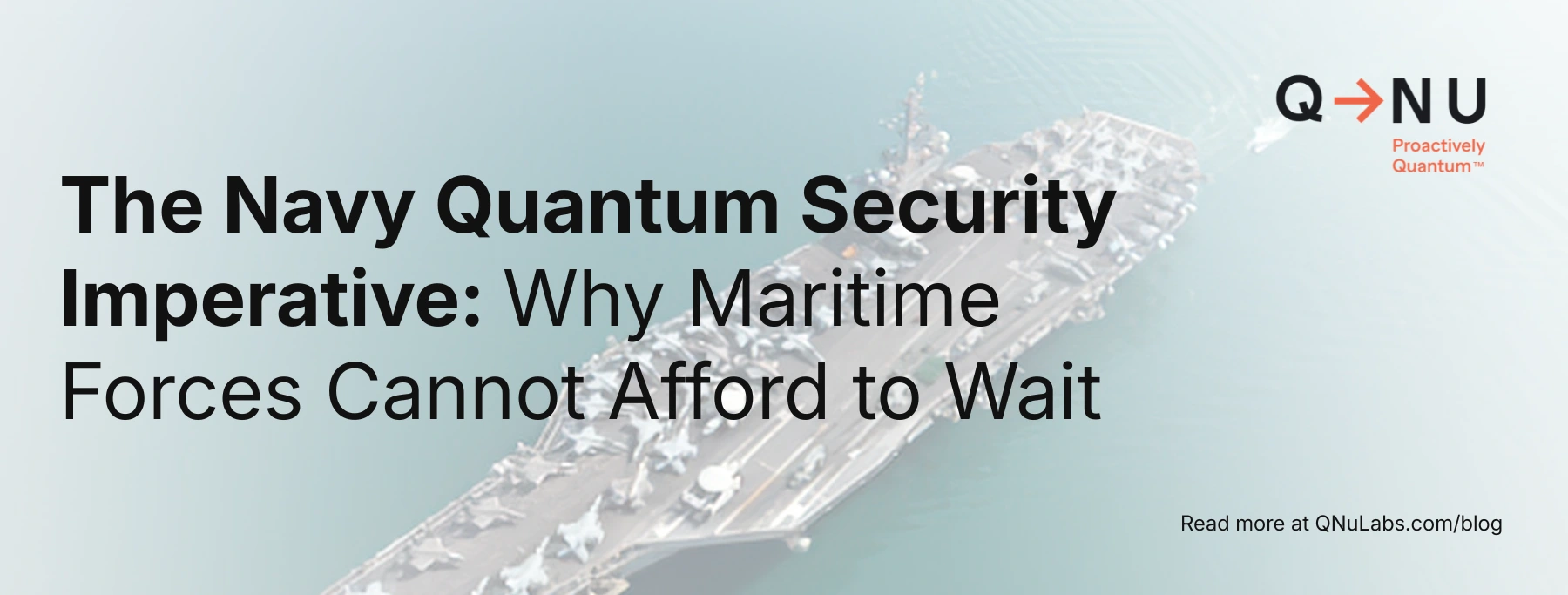
Maritime forces operate in one of the most communications-intensive and security-critical environments in modern defence. Shore-to-ship, ship-to-ship, fleet-to-theatre command, submarine communications, and satellite links all carry mission orders, sensor fusion feeds, targeting data, and blue-force tracking information. The integrity and confidentiality of that data directly influences combat outcomes.
Every one of those communication channels is currently protected by RSA or elliptic-curve cryptography (ECC). Both are broken by Shor's algorithm running on a cryptographically relevant quantum computer. The adversary does not need that computer today to begin attacking this data. The harvest-now-decrypt-later (HNDL) attack is passive and undetectable: collect the encrypted traffic now, store it, decrypt it when the quantum computer arrives. For communications that carry information with a 10-to-20-year strategic relevance horizon, as naval operational data routinely does, the HNDL threat means that data transmitted today may be readable by an adversary within the operational lifetime of the platforms it concerns.
Vice Admiral B. Sivakumar of the Indian Navy was explicit in March 2026: 'In modern naval operations, where ships, submarines, aircraft, and command centres are interconnected through complex communication networks, ensuring data security is critical. Quantum encryption technologies, particularly those based on quantum key distribution, have the potential to create communication channels that are virtually impossible to compromise. This assessment reflects the operational reality of every major maritime force, not a single nation's doctrine.
Naval communications face a set of constraints that differ significantly from terrestrial enterprise environments, and each constraint amplifies quantum vulnerability:
The communication channel between fleet command and operating vessels carries the most operationally sensitive traffic: mission orders, rules of engagement, intelligence assessments, and targeting data. This channel is typically satellite-relayed for surface vessels and acoustic for submarines. Both are encrypted using current public-key cryptography.
An adversary collecting this traffic today builds a dataset that, post-Q-Day, reveals operational patterns, command decision cycles, intelligence sources, and mission parameters. Even historical data has strategic value: understanding how decisions were made informs prediction of future decision-making. QKD-secured fleet command links eliminate this risk because the key material is generated and consumed in real time using quantum physics. There is no stored key to harvest.
Multi-vessel operations require continuous tactical data sharing: radar tracks, sonar contacts, blue-force positions, and threat assessments. These links are typically encrypted at the network layer using symmetric keys distributed via classical public-key mechanisms. Compromising the key distribution mechanism does not require breaking every message in real time. It requires retroactive decryption of enough messages to reconstruct the tactical picture.
Quantum Key Distribution for tactical network links provides information-theoretically secure key distribution. Any intercept of the quantum channel disturbs the quantum states and is immediately detectable. QNu's architecture has demonstrated 500 km QKD Network coverage with 4 nodes at 150 to 200 km spacing, against a global standard of 10 nodes for the same distance. Also, QNu demonstrated 1000 Km QKD Network in the critical sector.
Submarine communications are the most constrained environment in naval operations. Very low frequency (VLF) and extremely low frequency (ELF) transmission to submerged submarines operate at extremely low data rates: tens of bits per second. Every byte of bandwidth is precious. PQC algorithms have larger key and signature sizes than RSA. Implementation within submarine communications bandwidth constraints requires careful algorithm selection and message prioritisation. For surface ship connectivity periods, when submarines operate at periscope depth and can use satellite links, QKD key distribution is feasible. For deep-dive operations relying on VLF/ELF, the architecture requires pre-positioned quantum keys distributed during surface connectivity periods and consumed throughout the deep-dive operation: a quantum key wallet approach combined with PQC-protected signalling.
A complete quantum security implementation for a naval force requires four integrated layers:
Must-Know: Why QNu Labs Armos Is Validated for Maritime Environments
Armos QKD has been independently validated by many global and national institutes and is TEC approved, compliant with ETSI. Standard telecom fibre is what is installed in harbour facilities, coastal relay stations, and naval base connectivity. QNu's 4-node architecture delivers 500 km network coverage with 60% fewer relay infrastructure points than global standard approaches, reducing the capital cost and complexity of a national maritime quantum network. Free-space QKD variants of Armos support quantum safe networks where traditional terrestrial network is not available.
Defence procurement cycles typically run 5 to 10 years from requirement specification to operational deployment. If a quantum computer capable of breaking RSA-2048 becomes available in 2030, and procurement begins in 2027, the system will not be deployed before the threat is operational.
The NSA's Commercial National Security Algorithm Suite 2.0 mandates algorithm replacement for national security systems by 2030. [Source: NIST migration FAQ | encryptionconsulting.com June 2026] This is not a civilian commercial standard. It is the US government's own requirement for its own defence systems. Allied forces operating in coalition environments with US forces face an interoperability requirement that aligns with the 2030 deadline regardless of their own domestic timelines.
HNDL collection is already underway. State-level adversaries with the resources to build quantum computers have the resources to archive encrypted maritime communications traffic. Data transmitted by naval forces today is being collected. The question is not whether it will eventually be decrypted. For high-value traffic, it almost certainly will be. The question is whether the transition to quantum-secure communications happens before or after the adversary has the compute to read it.
A quantum readiness assessment for a naval force differs from an enterprise assessment in scope and complexity. Five domains must be addressed:
Naval forces are not debating whether quantum computers will eventually break current communications encryption. They are planning for when. The HNDL threat makes that timeline irrelevant for high-value data: what is transmitted today is already at risk. The responsible posture is a phased quantum security migration programme that begins with the highest-sensitivity, highest-shelf-life communications and extends across the full communications architecture within the procurement cycle window before 2030.
QNu Labs has ten years of production deployment experience, 25 naval QKD systems, and a validated architecture for quantum-secure maritime communications across the full stack. The brief for naval forces starts with a quantum readiness assessment.
Contact QNu Labs to begin.
Ready to take the next step?
Request a Naval Quantum Security Briefing: https://www.qnulabs.com/contact-us
Download: Telecom Quantum Threat Intelligence Report 2026-2035: https://www.qnulabs.com/whitepaper
Contact QNu Labs: https://www.qnulabs.com/contact-us
Related: Quantum Readiness Assessment Measures (QNu Blog)
Related: QKD Complete Guide: https://www.qnulabs.com/blog/quantum-key-distribution-qkd-complete-guide