
Are You Ready to Witness the Future of Data Security?
Platform
Resources
©2026 QuNu Labs Private Limited, All Rights Reserved.
Within weeks of each other in February and March 2026, three separate research teams sharply cut the estimated resources needed to break the public-key cryptography behind the internet: AQTI's JVG algorithm reported roughly 1,000x fewer quantum resources, Iceberg Quantum's Pinnacle architecture about tenfold, and Google Quantum AI extended the attack to the curve-based schemes guarding payments and blockchains. The resource estimate to break a 2048-bit key has fallen from about 20 million qubits in 2019 to under 100,000 in the newest architectures, driven by smarter Shor's algorithm implementations and error-correction design, not bigger machines. An industry coalition has named 2026 the "Year of Quantum Security," launching in Washington in January 2026 with senior officials from the FBI, NIST, and CISA.
Defenders have not moved at that pace. NIST plans to deprecate today's vulnerable algorithms after 2030 and disallow them after 2035, yet most enterprises still cannot say where that cryptography lives inside their own systems. Intrusions, meanwhile, are accelerating - The quickest quartile of attacks now reach data exfiltration in 72 minutes, down from 285 minutes a year earlier - and every record stolen today becomes a decryption candidate the moment a cryptographically relevant quantum computer (CRQC) arrives.
Key Takeaway: The race has already shifted from breaking encryption to replacing it before adversaries do.
You do not need a quantum computer to see what classical encryption is failing to protect. The CSIS Significant Cyber Incidents tracker logs dozens of attacks on critical infrastructure, governments, and banks in H1 2026 alone, while CrowdStrike's Global Threat Report names China-nexus and AI-augmented adversaries as systemic risks. The World Economic Forum reports 64% of organisations now factor geopolitics into cybersecurity planning, and Unit 42's 2026 incident data shows the fastest intrusions now reach data exfiltration in 72 minutes - down from 285 a year earlier.
The damage is concrete. In May 2026, ShinyHunters claimed 275 million records stolen from Canvas across 8,809 schools and universities. Banking is squarely in the crosshairs: Germany, the UK, and France absorbed 150+ ransomware attacks in Q3 2025; Dutch banks faced sustained pro-Russian DDoS campaigns; and CERT-EU flagged an actor accessing France's national banking accounts database via stolen credentials. In India, cyber-fraud losses crossed Rs 52,000 crore across nearly 60 lakh complaints, and a May 2026 incident at HDFC AMC sent its shares down nearly 3% in a single session.
Every breach above succeeded against classical cryptography. Every encrypted record stolen today is tomorrow's quantum-decryption candidate.
When quantum theory was born, science did not hand physicists a single answer - it handed them three. Heisenberg described it through matrices, Schrödinger through waves, and Dirac through an elegant new notation, and only later did the world realise all three were describing the same reality. Quantum-safe security works the same way. There is no lone silver-bullet algorithm; there are three complementary pillars - QKD, QRNG, and PQC - And genuine resilience comes from running them together, which is precisely the stack QNu Labs was built to deliver.
It flips the security model -from computational hardness to the laws of physics, layered across three pillars.
In Quantum Key Distribution (QKD), keys are encoded onto single photons. The moment an attacker measures one, its quantum state changes, making interception mathematically detectable. QKD does not replace classical encryption; it feeds quantum-distributed keys into robust symmetric ciphers, producing a tamper-evident channel no future compute power can break.
Beneath every key sits Quantum Random Number Generation (QRNG). Classical pseudo-random generators are deterministic, which makes them learnable by AI pattern-recognition models. True quantum randomness, sourced from physical photon behaviour, is non-repeatable by the laws of nature.
The third pillar is Post-Quantum Cryptography (PQC). NIST finalised three PQC standards in August 2024 -software-deployable across existing infrastructure. PQC scales to every endpoint of a global IP network, where QKD fibre cannot reach.
The hardest problem is organisational, not technical. Most enterprises do not know where their cryptography lives; a complete Cryptographic Bill of Materials (CBOM) for a tier-1 bank or telco can take a year. That is why crypto-agility -changing algorithms without re-architecting applications -matters more than any single algorithm choice. The winning strategy is hybrid: classical and post-quantum layered together, orchestrated through one control plane that selects the right primitive for each network path.
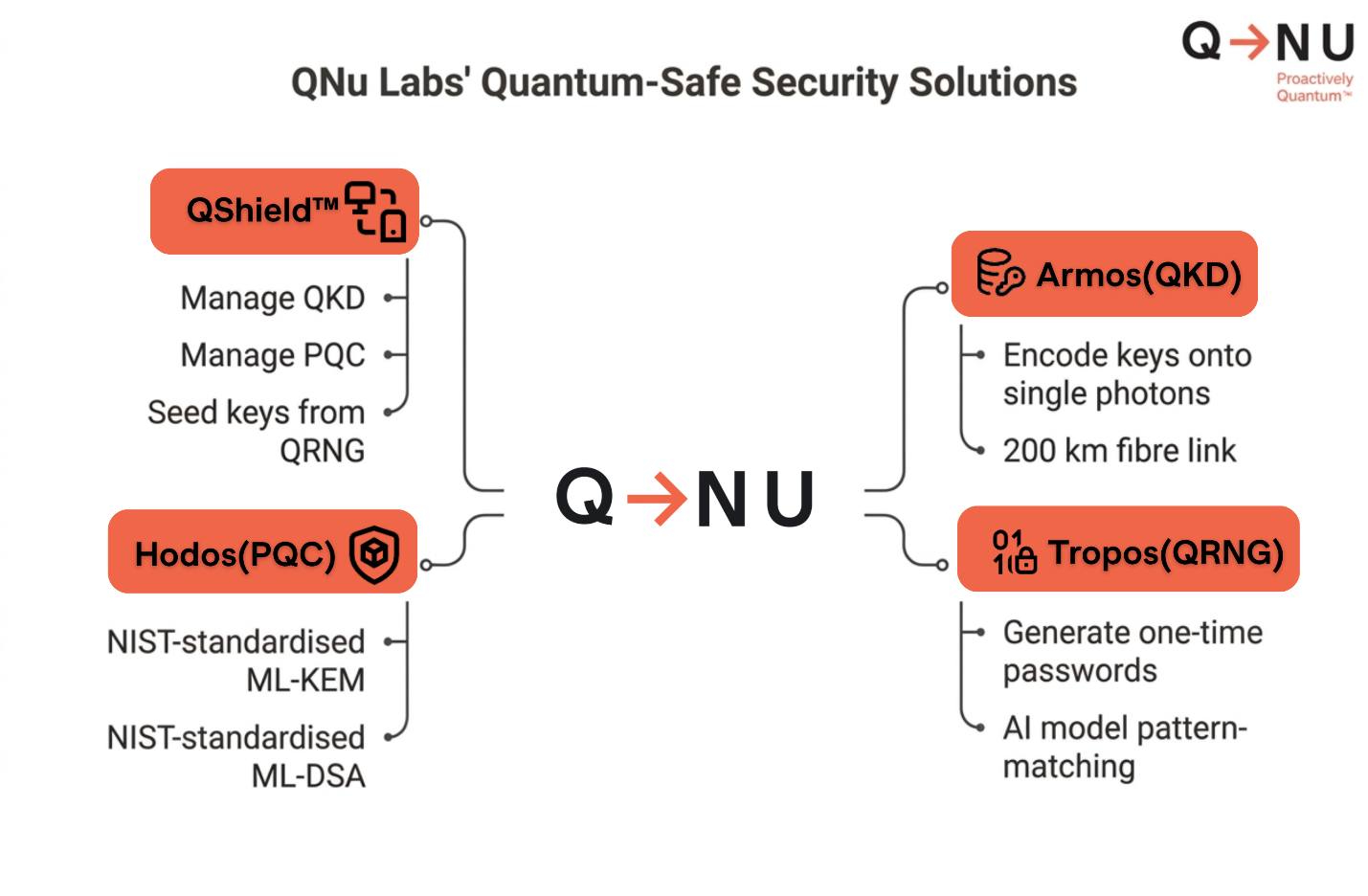
QNu Labs was built to solve the approaching collapse of public-key mathematics -across four scenarios every CISO recognises.
A defence command exchanging classified orders over a 200 km fibre link uses Armos (QKD) to encode keys onto single photons -the same technology powering India's 1,000-kilometre national quantum communication network.
A bank generating one-time passwords from a software RNG an AI model can pattern-match replaces it with Tropos (QRNG), producing entropy no model can predict because no algorithm produced it.
A telecom operator with thousands of TLS endpoints and a CNSA 2.0 deadline drops Hodos (PQC) -NIST-standardised ML-KEM and ML-DSA -in as middleware. No hardware swap, no rewrite, no downtime.
A multinational with data-centre fibre and field offices in 40 countries routes the fibre through QKD, the field offices through PQC, and seeds every key from QRNG -through one API managed via QShield™.
One platform. Four primitives. Every threat surface covered.
The regulatory timeline is now concrete. Right now, Harvest Now, Decrypt Later campaigns are actively collecting encrypted financial, government, and healthcare data for future decryption. By January 2027, the US requires quantum-resistant algorithms for all National Security Systems under CNSA 2.0. Between 2028 and 2032, the G7 Cyber Expert Group targets quantum-safe migration for critical financial infrastructure. And by 2030–31, National Quantum Missions including India's NQM, which targets intermediate-scale quantum computers of 50–1,000 qubits, mark essential rungs on the ladder toward cryptographically relevant hardware. By the time a CRQC is publicly announced, your data will have been captured years earlier.
Two failure modes have become indefensible:
The path starts with a cryptographic risk assessment to map exposure, then identifying systems storing data with a shelf life beyond the CRQC timeline, then adopting a quantum-safe platform spanning QKD, PQC, and QRNG without an infrastructure rebuild.
“Quantum-safe cryptography is not the upgrade. It is the floor. Everything above it - From RSA to ECC to every classical PKI in production -is a temporary roof on a building whose foundation is being replaced.”
The breakthroughs of 2026 did not announce a distant Q-Day; they compressed it. The organisations that navigate the next decade with their cryptographic infrastructure intact are the ones moving now -mapping exposure, building for crypto-agility, and deploying quantum-safe primitives before regulators, auditors, and adversaries force the issue at once.