

Are You Ready to Witness the Future of Data Security?
Platform
Resources
©2026 QuNu Labs Private Limited, All Rights Reserved.

~ RSA and ECC are being replaced because quantum algorithms like Shor's can break the mathematical problems they rely on — new standards such as ML-KEM, ML-DSA, and SLH-DSA introduce quantum-resistant cryptography based on lattice and hash-based methods instead.
~ The number of qubits needed to dismantle RSA-2048 has fallen sharply — from an industry estimate of roughly 20 million physical qubits in May 2025 to under 100,000 by March 2026.
~ No cryptographically relevant quantum computer (CRQC) exists yet, but the threat isn't about today's capability — it's about data stolen today being decrypted later.
~ "Harvest now, decrypt later" is no longer hypothetical — state actors are already collecting encrypted data, banking on future decryption.
~ The last comparable cryptographic transition, SHA-1 to SHA-2, took over a decade — a precedent that should worry any enterprise planning to start its PQC migration late.
Classical cryptography has secured digital infrastructure for nearly fifty years on the strength of hard mathematical problems. Post-quantum cryptography exists because those problems are no longer hard enough, not against a machine that doesn't yet exist, but against one that adversaries are already betting will exist before your data stops mattering. Understanding exactly what changes between the two is the difference between a migration plan and a guess.
Classical cryptography refers to the public-key algorithms that currently secure the vast majority of enterprise systems, RSA, Elliptic Curve Cryptography (ECC), and Diffie-Hellman key exchange. These algorithms derive their security from mathematical problems that are computationally infeasible for classical computers to solve at scale, even though the underlying maths has been public and studied for decades.
RSA, introduced in 1978, relies on the difficulty of factoring large composite numbers and supports key encapsulation, digital signatures, and certificate authorities and TLS handshakes. ECC uses elliptic curves over finite fields to provide equivalent security to RSA but with smaller key sizes, and is prevalent in mobile devices and blockchain systems. Both have been the default choice for TLS, VPNs, certificate signing, and code signing across virtually every enterprise system in production today.
Classical cryptography underpins certificate authorities, PKI hierarchies, HSM-backed key storage, VPN tunnels, and application-layer encryption across nearly every enterprise estate. Its ubiquity is precisely why the coming transition is so disruptive, there is effectively no enterprise system untouched by RSA or ECC somewhere in its dependency chain.
Key takeaway: RSA and ECC are so deeply embedded across enterprise infrastructure that a migration away from them touches almost every system, which is exactly why planning needs to start well before any forced deadline.
Post-quantum cryptography (PQC) is a family of cryptographic algorithms designed to remain secure against attacks from both classical and quantum computers. Unlike classical algorithms, which rely on factoring and discrete logarithm problems that Shor's algorithm solves efficiently, PQC is built on different mathematical foundations, primarily lattice-based problems and hash-based constructions, that have no known efficient quantum solution.
Unlike RSA and ECC, which derive their security from number-theoretic problems vulnerable to quantum attacks, algorithms like Kyber (now standardised as ML-KEM) rely on the learning with errors (LWE) problem over module lattices, a mathematical foundation believed to be resistant to both classical and quantum computational attacks. NIST finalised three PQC standards in August 2024: ML-KEM (FIPS 203) for key encapsulation, ML-DSA (FIPS 204) for digital signatures, and SLH-DSA (FIPS 205) as a hash-based signature alternative built on a structurally different mathematical foundation as a hedge against future cryptanalysis of lattice-based methods.
Key takeaway: PQC isn't one algorithm, it's a standardised family (ML-KEM, ML-DSA, SLH-DSA) built on different mathematical foundations, giving enterprises both a primary path and a structurally independent backup if one foundation is ever weakened.
Classical cryptography's security rests on problems that are hard for classical computers but efficiently solvable by a sufficiently powerful quantum computer running Shor's algorithm. Shor's algorithm targets asymmetric primitives for a complete break, an adversary with access to a CRQC can recover private keys from any RSA, ECDSA, ECDH, DSA, Diffie-Hellman, X25519, or Ed25519 ciphertext, exposing session keys, long-term signing keys, and archived ciphertexts alike. PQC's security rests on lattice-based and hash-based problems believed to resist both classical and quantum attack methods, a belief grounded in current cryptanalysis rather than a mathematical proof, which is why crypto-agility remains important even after migrating.
PQC algorithms generally require larger keys, larger signatures, and more computational overhead than their classical counterparts. Lattice-based algorithms like ML-KEM introduce meaningfully larger ciphertexts than ECC's compact key sizes, and hash-based signatures like SLH-DSA trade signature size for a more conservative security foundation. This affects certificate chain size, TLS handshake latency, and storage requirements at scale, which is why performance testing under real production load is a required step before any enterprise PQC cutover.
Classical cryptography is deeply embedded across decades of software, hardware, and protocol implementations, with mature tooling, broad library support, and near-universal interoperability. PQC deployment is accelerating but uneven: adoption is increasing across cloud providers, browser vendors, and operating system manufacturers, yet not every HSM, certificate authority, or legacy application supports the new algorithms yet — which is why hybrid deployment has become the standard migration pattern rather than a direct switch.
Key takeaway: The trade-off is straightforward — classical cryptography is smaller, faster, and universally supported but has a known, dated expiry; PQC is heavier and less universally supported today but has no known quantum break, which is why most enterprises are running both together rather than choosing one outright.
The threat isn't that a quantum computer capable of breaking RSA-2048 exists today, it doesn't. No CRQC exists in 2026, and the largest quantum computers today have only dozens of logical qubits, so a CRQC remains several hardware generations away. What has changed, and changed fast, is the engineering distance to that point. The number of qubits needed to dismantle RSA-2048 has fallen from an industry estimate of roughly 20 million in May 2025 to under 100,000 by March 2026, a shift from "twenty million near-perfect qubits" to a materially different and more concrete engineering brief: a few hundred thousand physical qubits, wired for fast surface-code cycles, feeding a very large magic-state factory. That's why the timeline compresses even while hardware progress looks incremental from the outside.
Germany's Federal Office for Information Security (BSI) tracks this threat in its recurring study on quantum computer development, with its most recent version published in December 2025, a signal that this isn't speculative industry marketing, but a risk national cybersecurity agencies are actively modelling and publishing on.
The most urgent reason to act isn't a future quantum computer, it's what's happening right now. "Harvest now, decrypt later" is no longer hypothetical: state actors and sophisticated adversaries are already collecting encrypted data with the expectation of decrypting it once quantum computers arrive, and any data that must remain confidential into the 2030s is at risk today. A harvest now, decrypt later attack doesn't require a working CRQC at the moment of interception, only the reasonable expectation that one will exist before the intercepted data's confidentiality window closes.
Key takeaway: The falling qubit requirement for breaking RSA-2048 matters less as a "when will it happen" number and more as evidence that the window for harvest-now-decrypt-later attacks to pay off is shrinking, meaning long-lived data is at risk today, not in some distant future.
The honest answer is: enterprises should have already started. The immediate action items are clear for most organisations, conduct a cryptographic inventory, and identify systems using RSA, ECC, and Diffie-Hellman before any PQC migration roadmap can be sequenced sensibly. Prioritisation should follow data sensitivity and confidentiality lifespan, systems protecting data that must stay confidential for five, ten, or twenty years sit at the top of the list, regardless of how "modern" the rest of the estate looks. Despite the urgency, only 38% of organisations have started a formal quantum-era strategy, a gap between known risk and actual readiness that most CISOs will eventually have to explain to their board.
Rather than a disruptive, all-at-once cutover, most enterprises are adopting hybrid cryptography — running classical and PQC algorithms in parallel during the transition. This preserves compatibility with clients and infrastructure that don't yet support PQC, while still closing the harvest-now-decrypt-later gap immediately. Historical precedent argues strongly for starting now: the migration from SHA-1 to SHA-2 took over a decade to complete, with many organisations maintaining vulnerable systems well beyond recommended timelines — and quantum timelines are compressing faster than that transition ever demanded.
Key takeaway: Waiting for certainty about quantum computing timelines is the wrong strategy — start with a cryptographic inventory now, prioritise by data sensitivity, and migrate via hybrid deployment so the transition doesn't repeat the decade-long drag of the SHA-1 to SHA-2 migration.
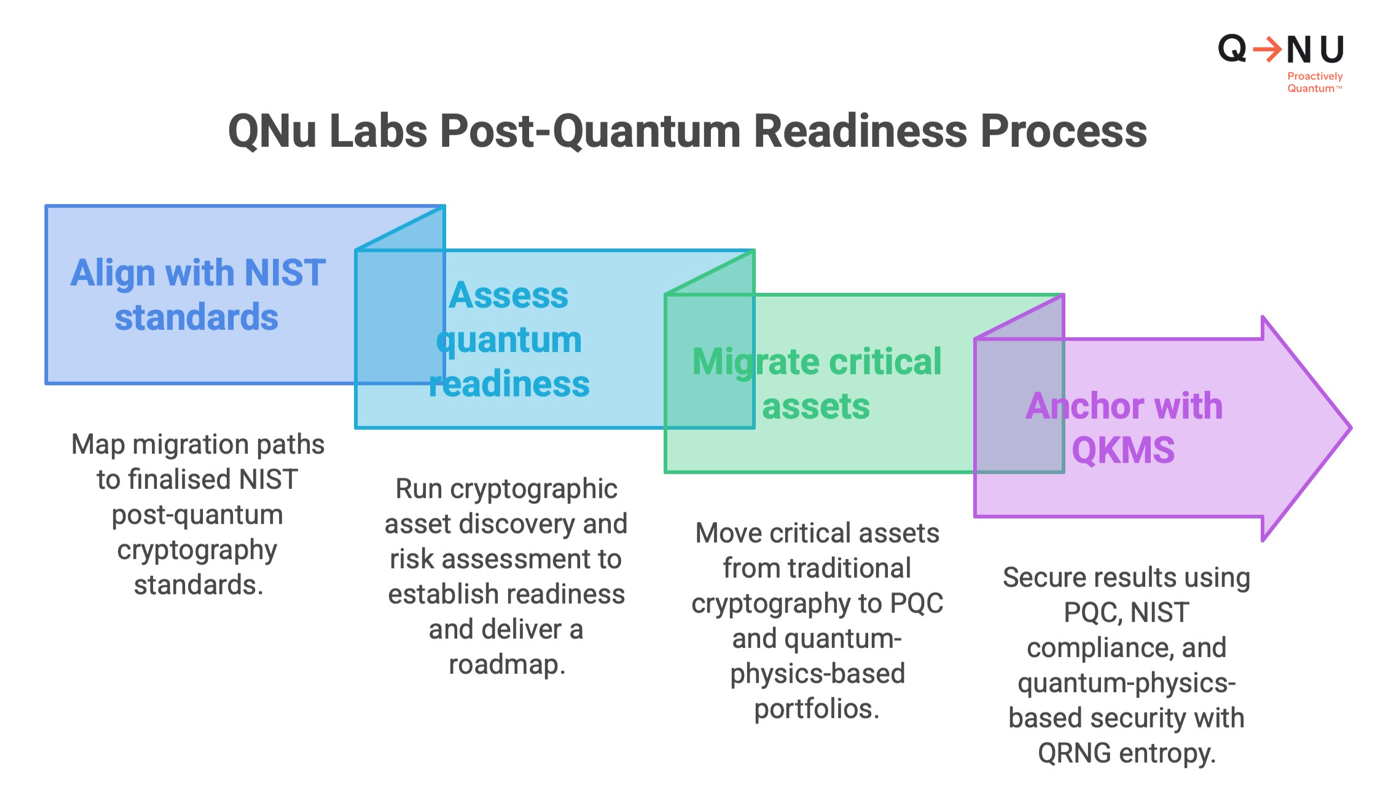
It begins with the standard. NIST has finalised its post-quantum cryptography standards, and every credible migration path now maps to them.
From there, QNu Labs runs cryptographic asset discovery and risk assessment to establish the organisation's quantum readiness, then delivers a roadmap against it. Migration starts with critical assets first, moving them from traditional cryptography to quantum cryptography using PQC alongside a quantum-physics-based portfolio, matched to the criticality of the data, its shelf life and its risk exposure, which varies from one organisation to another.
QKMS anchors the result: PQC based and NIST compliant, with an additional layer of quantum-physics-based security drawing true quantum entropy from QRNG as the root of trust.
Key takeaway: A structured, risk-prioritised migration path, inventory, hybrid deployment, phased rollout, turns quantum readiness from an abstract compliance exercise into a concrete, sequenced programme with a clear starting point.