

Are You Ready to Witness the Future of Data Security?
Platform
Resources
©2026 QuNu Labs Private Limited, All Rights Reserved.

AWS Key Management Service. Azure Key Vault. Google Cloud KMS. Between them, these three platforms protect the encryption keys of most of the world's enterprise data. They are fast, well-integrated, and widely trusted. They are also not quantum safe -- and in at least two of the three cases, they are not even close. The global Key Management as a Service market is projected to reach $142.83 billion by 2032 at a CAGR of 31.2%. [techaheadcorp.com/blog/multicloud-key-management-as-service-is-future] Virtually all of that growth is happening on infrastructure that cannot survive a cryptographically relevant quantum computer. This is not a vendor criticism. It is a structural problem with how cloud key management was designed -- and why a quantum-safe KMS is architecturally different, not just incrementally better.
A Key Management System (KMS) is the cryptographic backbone of an organisation's security posture. It handles the full lifecycle of encryption keys: generation, storage, distribution, rotation, revocation, and audit. Every database encrypted at rest, every TLS session, every digitally signed transaction, and every authenticated API call traces back to a key managed somewhere. In theory, a KMS is the most security-critical system in any enterprise's infrastructure. In practice, most organisations treat it as a cloud service checkbox.
Cloud KMS platforms are engineered for convenience. AWS KMS integrates natively with S3, RDS, Lambda, and hundreds of AWS services. Azure Key Vault handles secrets, certificates, and keys within the Microsoft ecosystem. [encryptionconsulting.com/aws-kms-vs-azure-key-vault-vs-gcp-kms] Google Cloud KMS provides key management for GCP workloads. All three are FIPS 140-2 validated and operationally reliable. The problem is not what they do. The problem is what they cannot do -- and what they are not designed to survive.
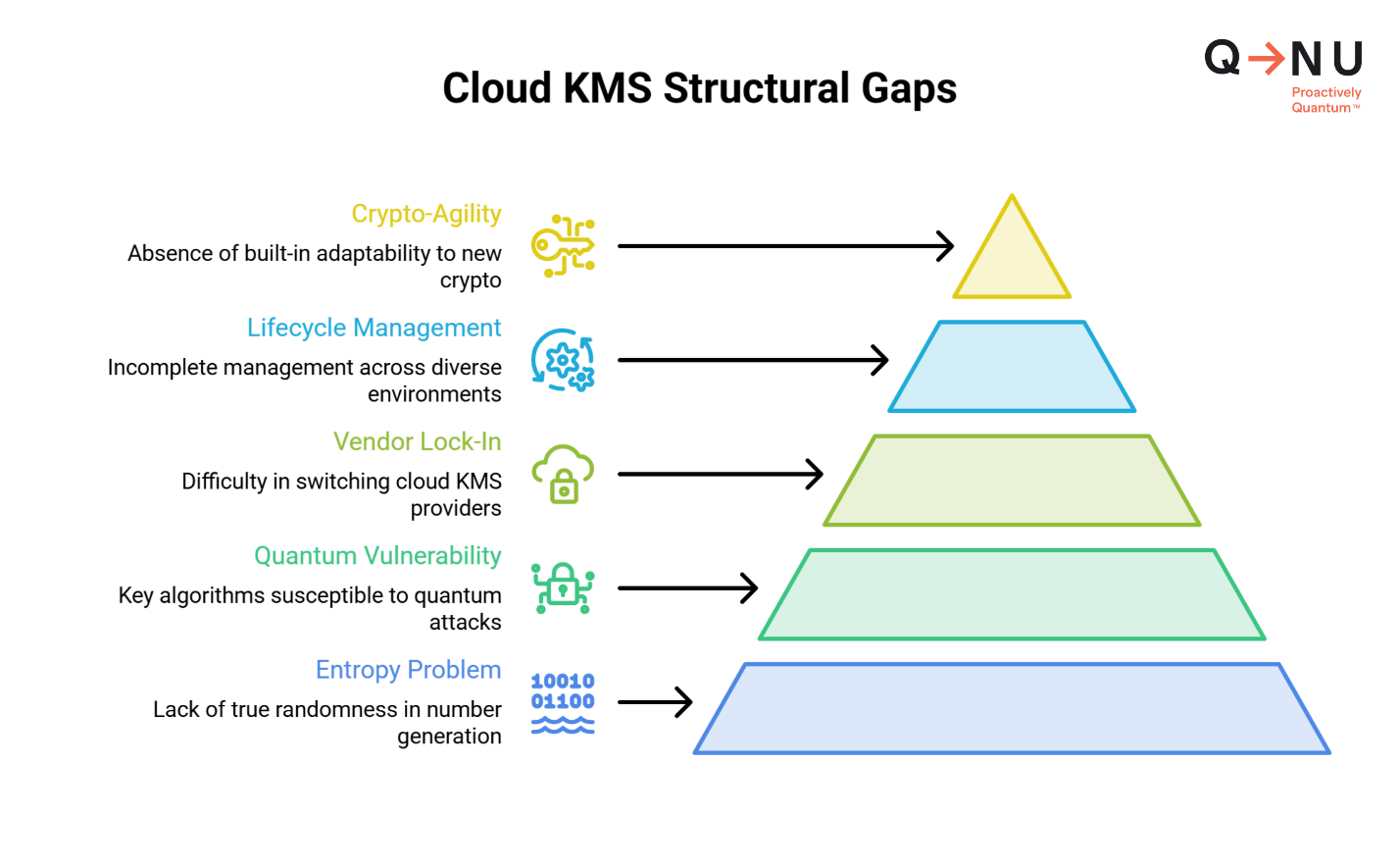
Every encryption key starts with randomness. The security of a key is only as strong as the quality of the entropy that seeded it. AWS KMS, Azure Key Vault, and Google Cloud KMS all use software-based pseudo-random number generation (PRNG) or hardware TRNG seeded from physical noise sources -- thermal variation, circuit timing jitter, and similar. Both approaches are computationally deterministic at some level. A sufficiently advanced adversary with knowledge of the seed state can predict or reproduce the output. A Quantum Random Number Generator (QRNG) is different by physical law: it derives entropy from quantum mechanical events -- photon detection, quantum vacuum fluctuations -- that are provably unpredictable by any classical or quantum adversary. [paloaltonetworks.com/cyberpedia/what-is-a-quantum-random-number-generator-qrng] No cloud KMS uses QRNG-seeded key generation. KyntraQ QKMS does.
Azure Key Vault supports RSA and Elliptic Curve keys only. [encryptionconsulting.com/the-debate-for-key-management-service-by-aws-or-azure] AWS KMS added opt-in ML-KEM support for TLS connections in 2025, requiring manual SDK updates and explicit feature activation. [techzine.eu/news/security/130431/aws-ml-kem-tls] Neither platform has migrated its core key storage and distribution infrastructure to NIST FIPS 203/204/205-aligned post-quantum cryptography algorithms. Harvest Now, Decrypt Later (HNDL) adversaries are storing cloud KMS-protected ciphertext today for future quantum decryption. A quantum-safe KMS uses ML-KEM, ML-DSA, and SLH-DSA natively -- not as a TLS-layer option.
AWS explicitly acknowledges that its External Key Store feature -- which allows keys to be stored outside AWS -- comes with significant tradeoffs: "greater risk to availability and latency will, for most customers, exceed the perceived security benefits." [docs.aws.amazon.com/kms/latest/developerguide/keystore-external.html] In other words, the architecture that would give you true sovereignty is the architecture AWS advises against using. Cloud KMS is engineered to keep your keys inside the vendor's control plane. For organisations in BFSI, defence, government, and regulated critical infrastructure -- particularly in India, the Gulf, and Southeast Asia -- this is not a preference issue. It is a compliance and national security issue. Sovereign, on-premise key management, where keys never leave your jurisdiction, is structurally incompatible with cloud-hosted KMS design.
Cloud KMS platforms manage keys within their own ecosystem. AWS KMS manages AWS service keys. Azure Key Vault manages Azure workload keys. Neither natively manages keys across on-premise infrastructure, legacy systems, OT networks, IoT devices, or multi-cloud environments without third-party tooling. The 2019 Capital One breach demonstrated exactly this gap: an IAM misconfiguration in AWS exposed KMS operations to an attacker who never touched the cryptographic algorithms themselves. [arxiv.org/pdf/2507.17655 -- HSM and TPM Failures in Cloud] Cryptographic security requires the perimeter around the KMS to be as strong as the KMS itself.
Crypto-agility is the ability to swap cryptographic algorithms independently of application logic, as NIST formalised in its March 2025 memo on modular cryptographic design. Cloud KMS platforms have algorithm roadmaps driven by their own release cycles. AWS decided to replace CRYSTALS-Kyber with ML-KEM in 2026 -- a decision made by Amazon, not by their customers, requiring active customer migration steps. [techzine.eu/news/security/130431/aws-ml-kem-tls] A quantum-safe KMS built for crypto-agility allows organisations to update algorithms, key lengths, and entropy sources independently, without waiting for a cloud vendor roadmap. The Fortanix December 2025 analysis confirmed: "not all key management systems are built for the seismic change quantum computing will bring." [fortanix.com/blog/cloud-kms-quantum-revolution]
A quantum-safe KMS is not a cloud KMS with a PQC checkbox. It is a platform built around four non-negotiable properties.
QRNG-seeded entropy: Key generation starts with provably unpredictable quantum randomness, certified to NIST SP 800-90B. No PRNG. No TRNG seeded from physical noise. Quantum physical phenomena -- photon detection, vacuum fluctuations -- as the entropy source. [paloaltonetworks.com/cyberpedia/what-is-a-quantum-random-number-generator-qrng]
Post-quantum algorithms natively: ML-KEM (FIPS 203), ML-DSA (FIPS 204), and SLH-DSA (FIPS 205) for all key types -- not as a TLS option, but as the platform default. RSA and ECDSA available for legacy compatibility only. [nist.gov/pqcrypto -- NIST PQC Standards, August 2024]
Sovereign, on-premise deployment: Keys generated, stored, and operated within the organisation's own physical infrastructure. No cross-border key material transit. No cloud control plane dependency. Mandatory for BFSI and defence in India, Gulf, and EU regulated environments.
Full lifecycle governance: Key generation, storage, rotation, revocation, distribution, and audit in one platform, spanning cloud, on-premise, OT, IoT, and hybrid environments. IBM has committed to enterprise key and certificate lifecycle management as a 2026 milestone on its security roadmap. [ibm.com/roadmaps/security] The capability gap between roadmap intent and operational reality is where KyntraQ QKMS operates.
A KMS that cannot survive Shor's algorithm is not a key management system. It is a key storage service with an expiry date.
Sources for the comparison above: [encryptionconsulting.com/aws-kms-vs-azure-key-vault-vs-gcp-kms] |[docs.aws.amazon.com/kms/latest/developerguide/keystore-external.html] |[techzine.eu/news/security/130431/aws-ml-kem-tls] |[fortanix.com/blog/cloud-kms-quantum-revolution]
[1] Fortanix -- Is Your Cloud Key Management Solution Ready for the Quantum Revolution? (Dec 2025) -- https://www.fortanix.com/blog/is-your-cloud-key-management-solution-ready-for-the-quantum-revolution
[2] Encryption Consulting -- AWS KMS vs Azure Key Vault vs GCP KMS (2025) -- https://www.encryptionconsulting.com/the-debate-for-key-management-service-by-aws-or-azure/
[3] Techzine -- AWS Introduces Post-Quantum Security with ML-KEM for TLS (April 2025) -- https://www.techzine.eu/news/security/130431/aws-introduces-post-quantum-security-with-ml-kem-for-tls-connections/
[4] AWS Documentation -- External Key Stores -- https://docs.aws.amazon.com/kms/latest/developerguide/keystore-external.html
[5] Palo Alto Networks -- What Is a Quantum Random Number Generator (QRNG)? -- https://www.paloaltonetworks.com/cyberpedia/what-is-a-quantum-random-number-generator-qrng
[6] ArXiv -- HSM and TPM Failures in Cloud: A Real-World Taxonomy and Emerging Defences (2025) -- https://arxiv.org/pdf/2507.17655
[7] IBM Security Roadmap 2026 -- https://www.ibm.com/roadmaps/security
[8] TechAhead -- Why Multicloud KMaaS Is the Future of Enterprise Encryption (2025) -- https://www.techaheadcorp.com/blog/multicloud-key-management-as-service-is-future/
[9] NIST -- Post-Quantum Cryptography Standards (FIPS 203, 204, 205) August 2024 -- https://csrc.nist.gov/projects/post-quantum-cryptography
[10] QCecuring -- AWS KMS vs Azure Key Vault vs Google Cloud KMS: Complete Comparison (Feb 2026) -- https://www.qcecuring.com/blog/aws-kms-vs-azure-key-vault-vs-gcp-kms