Are You Ready to Witness the Future of Data Security?
Platform
Resources
©2026 QuNu Labs Private Limited, All Rights Reserved.
Sixty percent of organisations experienced security exploits directly linked to weak or compromised PKI in 2025. Fifty-six percent faced service disruptions from certificate failures. And the average enterprise is managing over 114,000 internal certificates with just four full-time staff. (Source: BusinessWire)
PKI - Public Key Infrastructure was not built for the world we now operate in. It was built for a world of closed networks, human-scale identities, and long certificate lifetimes. That world ended. What replaced it - cloud, IoT, agentic AI, and an advancing quantum threat is dismantling PKI's foundations faster than most security teams realise.
This is not a future problem. It is today's baseline failure rate.
PKI provides the cryptographic framework for digital trust: Certificate Authorities (CAs) issue digital certificates that bind public keys to identities, enabling encrypted communication and authentication across systems, users, and devices.
For three decades, that model held. Networks were relatively closed. Certificate volumes were manageable. Lifetimes were long. The math - RSA and ECDSA were computationally unbreakable by anything that existed.
None of those conditions hold today.
A 2026 global study by the Ponemon Institute and CyberArk found that organisations now manage an average of 114,000 internal certificates, yet most dedicate only four full-time staff to the entire infrastructure. A separate HID survey of 300 IT and security leaders found that PKI-related incidents occur, on average, once per quarter across enterprises. Meanwhile, machine identities - devices, workloads, AI agents, containers - outnumber human identities 15 to one.
PKI was designed to secure a static world. The world is no longer static.
These are not edge cases. They are endemic failures documented across every major PKI study published between 2024 and 2026.
Failure 1: Certificate Sprawl and the Expiry Time-Bomb
Enterprises with tens or hundreds of thousands of certificates face a brutal arithmetic problem: certificates expire, and someone must track and renew every one. Entrust reports that 81% of companies suffered at least one certificate-related outage between 2023 and 2024. The average cost of a single outage runs from $500,000 to over $5 million. One high-profile case at ServiceNow - a platform serving over 80% of Fortune 500 companies - traced its root failure directly to a certificate error.
Failure 2: The 47-Day TLS Mandate - An Operational Tsunami
The CA/Browser Forum's Ballot SC-081v3 has set a phased reduction of TLS certificate lifetimes: 398 days → 200 days (March 2026) → 100 days (March 2027) → 47 days mandatory by March 2029. For an organisation managing 100,000 certificates at 47-day validity, that means renewing approximately 2,100 certificates every single day. No manual team can sustain that. PKI infrastructure not built for automation will not survive this transition.
Failure 3: The CA Trust Model Is Centralised and Fragile
PKI's entire architecture rests on the trustworthiness of Certificate Authorities. If a CA is compromised, attackers can execute man-in-the-middle attacks at scale - intercepting, reading, and altering communications while appearing legitimate. The 2026 CyberArk/Ponemon study found that 60% of organisations experienced exploits as a direct result of weak cryptography in their PKI. (Source: Businesswire) The trust model has one structural flaw: it is hierarchical, centralised, and catastrophically breakable at the top.
Failure 4: Visibility Is Close to Zero
A DigiCert report found 75% of organisations struggle to manage PKI, largely because they cannot inventory what they have. Certificates issued by shadow IT, legacy systems, and decentralised teams accumulate invisibly. You cannot protect what you cannot see.
Failure 5: Agentic AI Has Broken PKI's Identity Model
Gap - This failure appears in no other PKI blog
AI agents do not behave like human users or even traditional machines. They spawn sub-agents, rotate sessions at millisecond intervals, create ephemeral identities, and operate across nested delegation chains. Classical PKI was never designed to manage cryptographic identities at this velocity. The SANS Institute's April 2026 survey flagged poor credential hygiene as an enterprise-wide risk, and Forrester has predicted at least one major publicly-disclosed breach driven by agentic AI credential failure before the end of 2026. Any organisation deploying AI agents without rethinking its identity and key management layer is running a live experiment in uncontrolled trust.
Failure 6: IoT and OT Hardware Are Cryptographically Frozen
Critical infrastructure - industrial controllers, medical devices, utility sensors, defence systems - runs on devices with operational lifetimes of 15 to 20 years. Most have RSA or ECC hardcoded directly into firmware at the point of manufacture. PKI cannot revoke or replace these cryptographic implementations without physical hardware replacement. These devices are already in your network, and they will still be there in 2034. PKI has no answer for them.
Failure 7: Sovereign PKI Does Not Exist for Most Nations
Gap - This failure appears in no other PKI blog
Enterprises in India, the Gulf, and Southeast Asia - including banks, telecoms, and defence contractors - largely depend on Western Certificate Authority hierarchies for their digital trust infrastructure. If a foreign root CA is revoked, compromised, or geopolitically restricted, national critical infrastructure faces cascading failures. For organisations handling sovereign data, this is not a theoretical risk. It is a structural dependency that PKI, as currently architected, cannot resolve.
PKI's cryptographic foundation - RSA and ECDSA - rests on mathematical problems that a sufficiently powerful quantum computer running Shor's algorithm can solve in polynomial time. When that happens, every certificate PKI has ever issued becomes untrustworthy.
But the threat is not waiting for Q-Day to arrive.
Harvest Now, Decrypt Later (HNDL) attacks are operational today. Nation-state adversaries are intercepting and storing encrypted TLS traffic - secured by PKI certificates - with the explicit intent to decrypt it once a cryptographically relevant quantum computer (CRQC) is available. Data encrypted in 2026 may be readable by 2034. The Federal Reserve's 2025 research paper confirms HNDL represents a present-day risk, not a future scenario.
NIST finalised its first post-quantum standards in August 2024 - ML-KEM (FIPS 203), ML-DSA (FIPS 204), and SLH-DSA (FIPS 205) - and plans to deprecate quantum-vulnerable algorithms by 2035. Post-quantum PKI migration is not an algorithm swap. It is a full overhaul of X.509 certificate formats, Certificate Revocation Lists, OCSP protocols, and trust anchor hierarchies. (Source: Arxiv)
An ISACA 2025 global poll found 62% of technology professionals are worried that quantum computing will break current encryption, but only 5% have made it a near-term high-priority. Meanwhile, over 50% of human-initiated web traffic through Cloudflare already uses post-quantum key agreement as of October 2025. Enterprise PKI lags the public internet by years.
Managed PKI solves operational complexity. It does not solve quantum vulnerability or data sovereignty. Cloud PKI introduces cross-border data dependencies that are antithetical to BFSI and defence requirements. Dropping in NIST PQC algorithms addresses the mathematics but leaves the key lifecycle, revocation infrastructure, key storage, and distribution layer entirely untouched.
The missing layer is a quantum-safe Key Management System (QKMS). PKI issues an identity. KMS governs the cryptographic keys behind that identity - managing their lifecycle, securing their storage, seeding entropy through hardware-grade quantum random number generation, and enforcing policy through every rotation and revocation event. Without a QKMS layer beneath PKI, post-quantum migration is architecturally incomplete. You have changed the locks. You have not changed the key management vault behind them.
The PKI Consortium's Maturity Model (PKIMM) - the industry benchmark for measuring cryptographic infrastructure health across 15 categories - now has a post-quantum layer. The PKI Consortium PQC Working Group released a draft Post-Quantum Cryptography Maturity Model (PQCMM) in October 2025, defining structured maturity levels for PQC adoption across all products and solutions that rely on cryptography, with plans for it to become the basis of independent industry certification. Level 5 'Optimised' status now explicitly requires PQC readiness.
The uncomfortable truth: most organisations sitting at self-assessed Level 3 or 4 have no cryptographic inventory, no QRNG-seeded key management, and no migration roadmap. A full PKIMM assessment takes 2–4 weeks - but remediation from Level 2 to Level 4 takes 12–24 months of infrastructure rewiring. With the US Cyber Strategy 2026 now treating PQC as a federal infrastructure mandate, and the US House Science Committee advancing the National Quantum Initiative Reauthorization Act in April 2026 to fund state and local PQC migration, the maturity clock is no longer theoretical. The White House estimates federal PQC migration will cost up to $7.1 billion between 2025 and 2035. The organisations that start in 2026 will spend a fraction of what late movers will pay. KyntraQ QKMS is built to accelerate organisations from assessment to Level 4 compliance - with FIPS 203/204/205-aligned key lifecycle management, QRNG entropy, and sovereign on-premise deployment - without replacing your existing PKI infrastructure overnight.
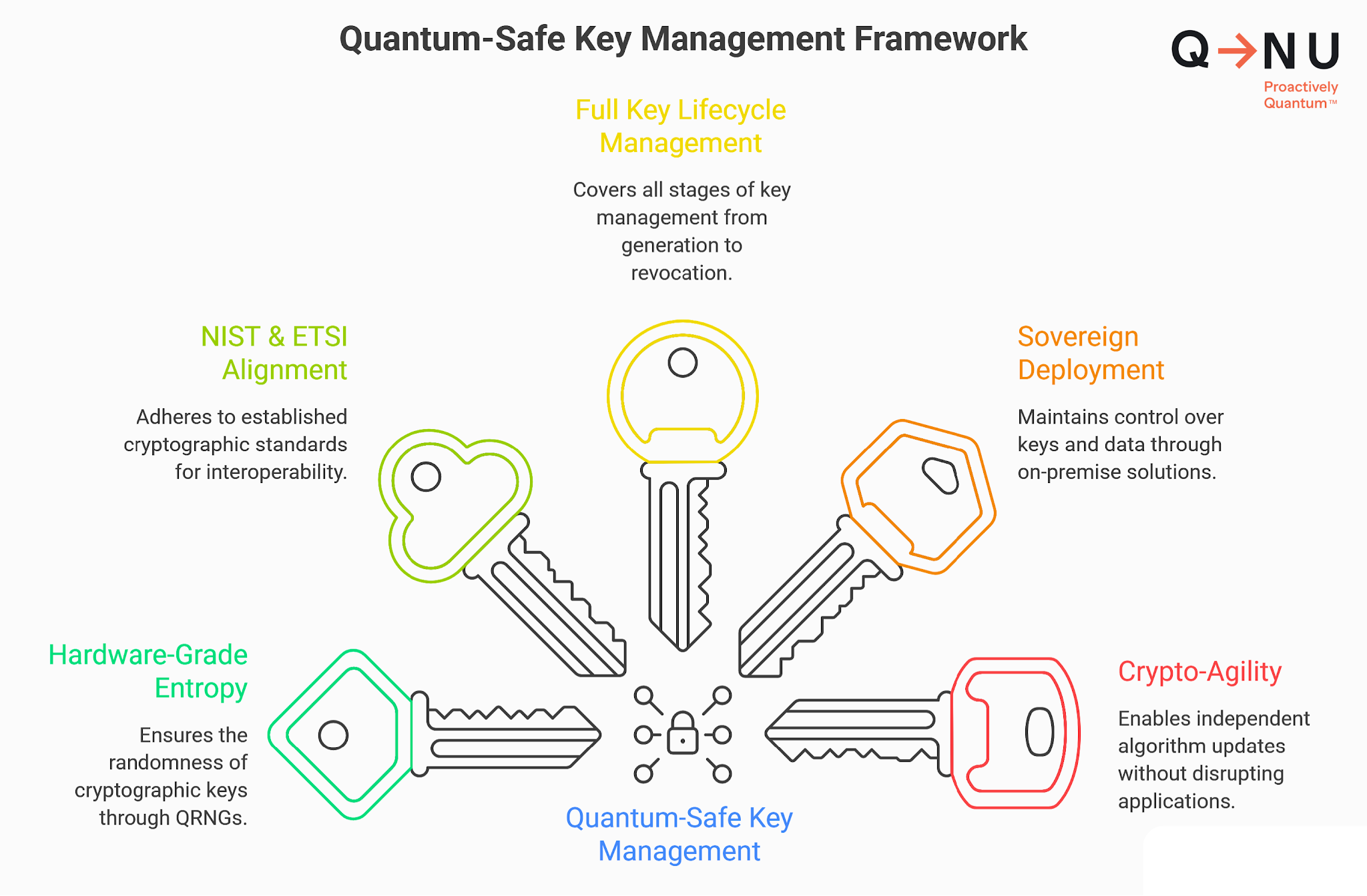
The answer is not a single product. It is a stack.
Quantum-safe key management requires: Hardware-grade entropy from a Quantum Random Number Generator (QRNG); cryptographic algorithms aligned to NIST FIPS 203/204/205 and ETSI standards; full key lifecycle management covering generation, storage, rotation, revocation, and audit; and sovereign, on-premise deployment that eliminates cross-border dependency.
Critically, this stack must be built for crypto-agility - the ability to swap cryptographic algorithms independently of application logic, as formalised in NIST's March 2025 memo on modular cryptographic design. (Source: OSA) Crypto-agility is not a product you buy. It is a design principle you embed. PKIMM Level 5 requires it. Regulators are beginning to mandate it. Adversaries are already exploiting its absence.
The question every CISO should be asking right now is not 'are we quantum-safe?' It is: 'Do we have a key management layer that can enforce that answer - and prove it to an auditor?'
The Question Is No Longer Whether Your PKI Will Fail. It Is Whether You Will Know It Has.
PKI's structural weaknesses - certificate sprawl, fragile CA trust, agentic AI blind spots, IoT deadlocks, sovereign dependency, and a quantum threat already in motion - are not warnings. They are the current operating conditions.
The organisations that will navigate the next decade with their cryptographic infrastructure intact are the ones that move now: completing a PKIMM assessment, closing the key management gap, and building for crypto-agility before regulators, auditors, and adversaries force the issue simultaneously.