Are You Ready to Witness the Future of Data Security?
Platform
Resources
©2026 QuNu Labs Private Limited, All Rights Reserved.

The US Treasury Just Called an Emergency Meeting Over AI Cybersecurity Threats.
On 8 April 2026, US Treasury Secretary Scott Bessent and Federal Reserve Chair Jerome Powell summoned the CEOs of America's biggest banks to an emergency meeting at Treasury headquarters in Washington. Citigroup, Morgan Stanley, Bank of America, Wells Fargo, and Goldman Sachs – All in one room.
The agenda was a single AI cybersecurity threat that regulators now consider a systemic risk to the global financial system.
A new AI model called Mythos, built by Anthropic, can find and exploit software vulnerabilities across every major operating system and web browser with no human intervention. Anthropic's own red team confirmed that Mythos can chain three, four, or even five separate vulnerabilities into a complete autonomous attack.
The Guardian reported that Anthropic published a warning stating AI models have now surpassed "all but the most skilled humans at finding and exploiting software vulnerabilities." The company added that the fallout for economies, public safety, and national security "could be severe."
The meeting took place while bank executives were already in Washington for an industry gathering. Regulators focused the guest list on heads of systemically important banks, signalling that a cyberattack on any one of them could destabilise the entire global financial system.
This was not a briefing or an advisory note. It was a government-level emergency that reframes AI cybersecurity threats as a direct risk to financial stability.
The US government's message to Wall Street is clear: AI-powered cyberattacks are no longer an IT concern. They are a systemic risk to financial stability.
That distinction changes everything. An IT concern earns a budget line and a quarterly review. A systemic stability risk brings the Treasury Secretary and the Fed Chair into the same room, demanding answers from the leaders of the world's largest banks. The concern is not about one model. It is about an entire category of AI-driven threats that operate at a speed and scale that human security teams cannot match.
Traditional cyberattacks require human hackers to find weaknesses, write exploits, and execute them manually. That process takes weeks of skilled effort and limits how many targets an attacker can hit. AI removes those constraints entirely.
Now consider that capability aimed at banking infrastructure, payment networks, SWIFT messaging, and core banking links that process billions of dollars in transactions every day. That is what prompted the emergency meeting.
The Banking Encryption Problem That AI Just Exposed
Every banking system on earth relies on classical cryptographic algorithms like RSA, ECC, and Diffie-Hellman. These algorithms protect OTPs, digital signatures, TLS sessions, encrypted databases, and inter-bank settlements. They have worked reliably for decades because breaking them requires more computing power than any classical machine can deliver.
AI changes that equation in a fundamental way. Models like Mythos do not try to brute-force encryption. Instead, they find implementation flaws - the gaps in how organisations deploy, configure, and maintain their encryption systems. They do this faster and more accurately than any human security team.
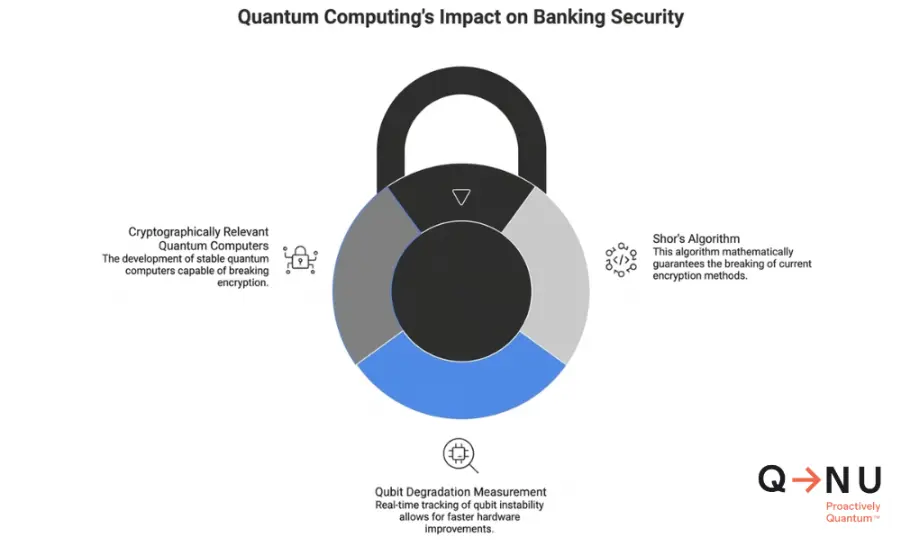
Quantum computing adds a second front to this attack. When quantum machines reach sufficient scale, they will not need to find implementation flaws at all. They will break the underlying mathematics that RSA, ECC, and Diffie-Hellman depend on. Shor's algorithm makes this mathematically certain.
This threat is accelerating faster than most security leaders expect. Researchers at the Niels Bohr Institute recently revealed a breakthrough in tracking how quickly quantum information degrades inside processors. For the first time, scientists can measure qubit degradation in real time over 100 times faster than previous methods allowed.
This matters because instability has been the biggest barrier to building a cryptographically relevant quantum computer. Qubits lose information unpredictably, and scientists could not measure the loss fast enough to fix it. Now they can. The breakthrough means quantum hardware faults are being diagnosed and corrected at unprecedented speed, bringing encryption-breaking machines closer to reality.
The financial system now faces a two-front threat. AI models exploit weaknesses in how banks use encryption today. Quantum computers will break the encryption mathematics itself within years. Classical security cannot survive on both fronts.
Three core capabilities make QNu's platform directly relevant to the AI and quantum threats the US government just flagged:
Quantum Key Distribution (Armos) sends encryption keys using single photons of light. If anyone attempts to intercept a key, the photon's quantum state changes and the system detects the intrusion instantly. No AI model and no quantum computer can circumvent the laws of physics. This is not computational security that improves with longer keys. It is physics-based protection that no amount of processing power can defeat.
Quantum Random Number Generation (Tropos) creates encryption keys from quantum physical processes rather than mathematical algorithms. Classical random number generators are deterministic, which means AI can learn to predict their output. Pattern recognition in pseudo-random sequences is exactly the kind of task AI models excel at. Tropos produces genuinely random output that nothing can predict or reproduce, certified to NIST SP 800-90B standards.
Post-Quantum Cryptography (Hodos) deploys NIST's finalised quantum-resistant algorithms, including ML-KEM and ML-DSA, as middleware into existing banking infrastructure. Banks do not need to replace hardware or disrupt operations. This is what crypto-agility looks like in practice — quantum-safe encryption delivered into the systems organisations already run.
QShield™ integrates all three capabilities into a single platform with one API. The system switches automatically between QKD and PQC depending on the network path, while QRNG generates every encryption key. For a bank, one platform secures core banking links, SWIFT messages, OTP generation, and customer-facing applications without requiring multiple vendors or fragmented dashboards.
→ Explore how QNu secures banking and financial services
The Mythos emergency meeting is not an isolated event. It fits into a regulatory and threat timeline that is compressing rapidly:
The US government did not advise banks to monitor this situation. They summoned CEOs to Washington for an emergency meeting. The urgency of that signal should not be underestimated.
→ Assess your organisation's quantum readiness now
The US Treasury Secretary considered AI cybersecurity threats serious enough to call an emergency meeting with the leaders of Citigroup, Goldman Sachs, and Morgan Stanley. The question every organisation should now ask is straightforward: what are we doing about this?
The recommended path starts with a cryptographic risk assessment to map your exposure. Identify which systems store data with a shelf life that extends beyond the quantum threat timeline. Then adopt a quantum-safe security platform that addresses both AI exploitation and quantum decryption without requiring a complete infrastructure rebuild.
"AI has proven it can outperform human hackers. Quantum computing will outperform classical encryption. Quantum-safe security is the only approach that addresses both threats. The time to deploy it is before you need it, not after the data has already been harvested."
Ready to understand your exposure? Talk to QNu's expert team or request a live demo of the QShield™ quantum-safe security platform today.
→ See how a global bank achieved 100% quantum-safe compliance with QNu
Sources & External References